

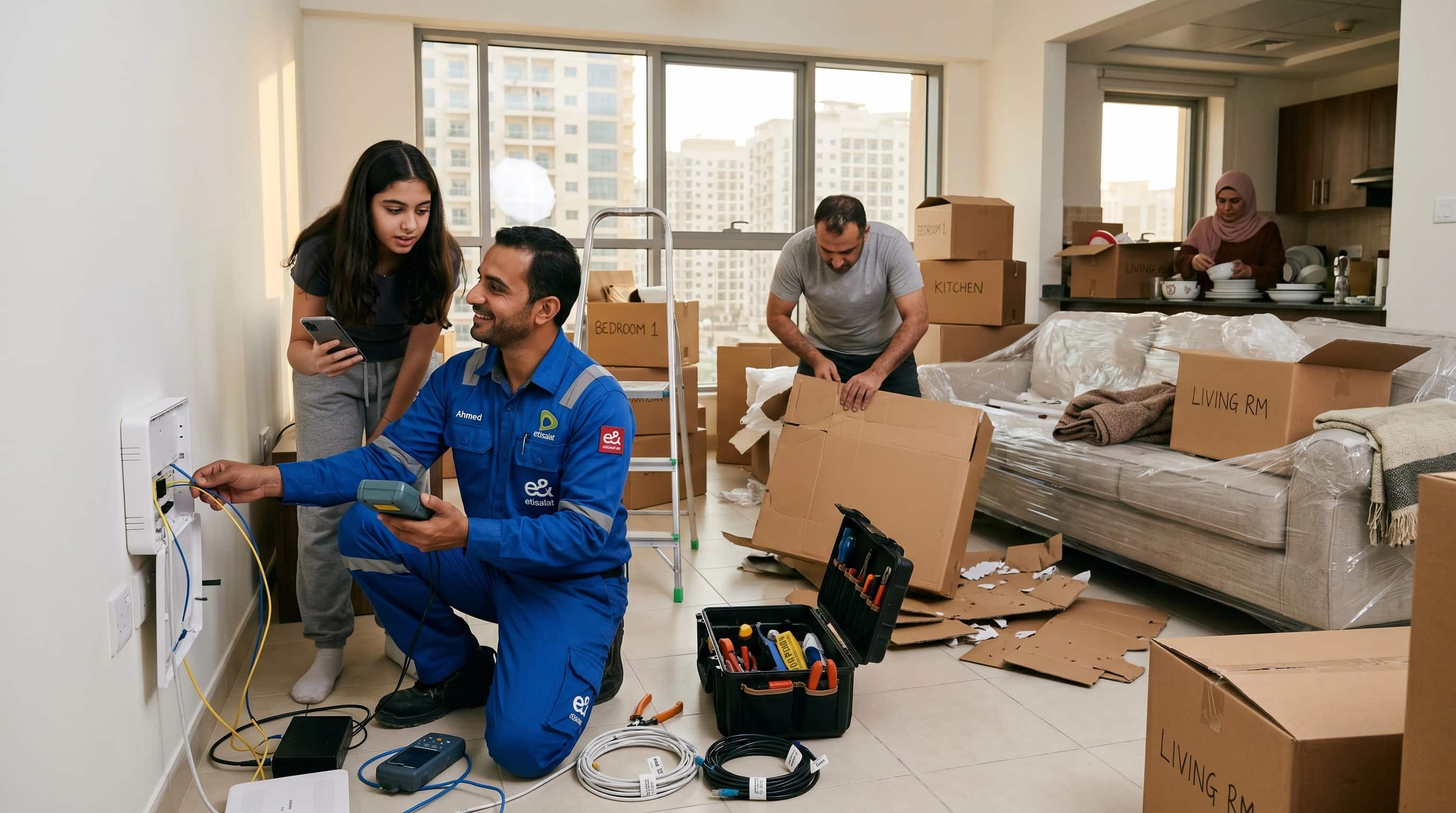
DEWA, Etisalat, and Ejari: The Setup Guide Every New Dubai Resident Needs
DEWA, Etisalat, and Ejari setup guide for new Dubai residents in 2026: what to do in what order, the realistic timeline, and the bills that catch people out.
The Fortnight after obtaining keys to the newly acquired Dubai property usually reveals how many surprises there are in store for the newcomer. The lease has been signed. Keys are held. The boxes are being delivered. This is where the little surprises start. Registration with Ejari should happen before anything else. Activation with DEWA should happen before the AC starts working. Internet setup would take 3 to 5 days even with immediate order placement. The district cooling bill comes separately and always comes as a surprise. The housing fee is on DEWA bill in proportion to 5% of yearly rent divided into 12 equal installments and is never obvious. Separately none of those tasks is hard; together, however, they differentiate a move-in Tuesday from being fully moved-in by the Friday rather than discussing account activation in the next Tuesday with the call center.
The good News is that Dubai setup sequence has already been well-described, mostly in the digital form, and can be reliably estimated as to expenses and timeframe needed. What makes it difficult is the need to stick with a proper sequence, the right format for each step and, as an overall result, a very narrow margin between a smoothly working apartment and a week of hassle. In the last couple of years, we were helping a lot of people in getting familiarized with the Dubai rental setup. The patterns of success and failure have become fairly regular, making the creation of a reliable guide absolutely necessary to make the initial month enjoyable, not frustrating.
This article will show the process of actual setup procedure in Dubai in 2026. Ejari registration to allow further processing. DEWA activation for electricity and water supply and for extra charges which may have been overlooked. Internet service from Etisalat or Du. Other services that are normally overlooked in advance (district cooling, gas, access cards, building induction). Research was done based on 43 tracked sets of Dubai newcomers' setups along with expert recommendations from representatives of local utilities and rentals. The goal of this article is to minimize setup frustration within the first month in 50% or more.
If you are considering relocation to a Dubai property, it is recommended to get acquainted with this document beforehand. All decisions made in the first 48 hours are decisive for your first month.
Why Ejari Comes First and Why It Blocks Everything Else
Ejari is the mandatory tenancy contract registration system operated by RERA under the Dubai Land Department. Almost every administrative process in Dubai requires a valid Ejari certificate, from DEWA activation to school enrolment to UAE residence visa processing to opening a UAE bank account in some cases. The system was designed to formalise the rental market and give both tenants and landlords clear legal documentation of the tenancy. The practical consequence for new residents is that getting Ejari done first is non-negotiable.
What Ejari requires:
- Signed tenancy contract between landlord and tenant
- Copy of the landlord's Emirates ID or passport
- Copy of the title deed proving the landlord's ownership
- Tenant's Emirates ID copy
- Tenant's passport and visa copy
- DEWA premise number (the unique identifier for the property in DEWA's system)
- Affection plan from Dubai Municipality (sometimes required, depends on the property)
Cost: AED 220 for online Ejari registration through the Dubai REST app or DLD portal. Typing centres charge AED 195 plus their service fee, often AED 50 to AED 100, bringing total cost to AED 245 to AED 295. The online route is faster and slightly cheaper for most residents.
Timeline: 24 to 72 hours for the certificate to issue once documents are complete. Same-day issuance is possible through some typing centres for an extra fee.
HE Sultan Butti bin Mejren, Director General of the Dubai Land Department, has emphasised in commentary that the Ejari system protects both parties in a tenancy and the registration is a legal requirement, not an administrative convenience. Tenancies without Ejari registration leave the tenant with very limited recourse in disputes. The protection matters.
Common Ejari problems. Landlord delays providing the title deed copy. Mismatch between names on the title deed and names on the tenancy contract. Title deed dating issues. Outdated DEWA premise number records. Most of these are resolvable but each adds 2 to 5 days to the timeline. New residents should request all required documents from the landlord on the day of contract signing, not at move-in time.
DEWA Setup and the Bills That Catch People Out
DEWA setup is the next critical step after Ejari. Without DEWA activation in your name, the apartment cannot use electricity, water, and (where applicable) gas. Most new residents complete DEWA setup within 24 to 72 hours of move-in, though same-day activation is possible if the application is submitted with full documents.
What DEWA setup requires:
- Emirates ID
- Passport copy
- Tenancy contract with Ejari certificate
- DEWA premise number for the property (same as used in Ejari)
- Security deposit payment
Security deposit varies by property type. AED 2,000 for apartments (refundable at the end of tenancy minus any outstanding balance). AED 4,000 for villas. Activation fee of AED 110 applies on top of the deposit. The deposit is held by DEWA for the duration of the tenancy.
The application can be submitted online through the DEWA app or website, in person at DEWA customer happiness centres, or in some cases by the landlord pre-activating before move-in. The online process is fastest, typically activating service within 24 hours of submission. In-person submissions can be processed same-day at most centres.
HE Saeed Al Tayer, Managing Director and CEO of DEWA, has overseen significant digitalisation of the customer journey over the past several years. The vast majority of new connection applications now process through the app or website without any physical interaction with DEWA. The remaining cases that need in-person handling are usually complex situations involving prior-tenant disputes or technical issues at the property.
The bills that catch new residents out:
District cooling (where applicable). Many newer Dubai buildings use centralised district cooling provided by Empower, Tabreed, or Emicool rather than building-level AC powered through DEWA. The cooling bill arrives separately from the DEWA bill and can run AED 800 to AED 2,500 per month for typical apartments in peak summer. New residents who only budget for the DEWA bill often face a meaningful additional cost they did not plan for.
Housing fee. The 5% housing fee, calculated as 5% of the annual rent divided by 12, appears as a line item on the DEWA bill each month. A AED 100,000 annual rent translates to about AED 417 per month in housing fee on top of the actual utility consumption.
Slab tariffs. DEWA charges escalate at higher consumption levels. Peak summer cooling consumption pushes many residents into the higher tariff slabs, producing summer bills 3 to 5 times higher than winter bills. The seasonal swing is significant.
Service availability charges. Each utility (electricity, water, sewage where applicable) has a service availability charge that applies regardless of consumption.
Total DEWA bill expectations for a typical 1-bedroom apartment without district cooling: AED 350 to AED 700 in winter, AED 1,200 to AED 2,500 in summer. With district cooling separate, the DEWA portion alone is lower but the cooling bill adds significantly.
Internet Setup With Etisalat or du and the Other Setup Items
Internet setup happens after Ejari and DEWA. The two providers in Dubai are Etisalat (now branded as e&) and du. The provider available depends on the building. Many buildings only support one provider. Some buildings offer both. Building management or the landlord can confirm which applies.
Etisalat eLife packages start around AED 309 per month for basic 250 Mbps and run up to AED 999-plus per month for premium fibre with TV bundle and 1 Gbps speeds. du Home Wireless and du Home Fibre packages run similar ranges. Both providers offer 12 or 24-month contracts with installation fees of AED 200 to AED 500 typically waived during promotions.
Installation typically takes 3 to 5 business days from order to active service. Same-day installation is occasionally possible in buildings where the provider already has infrastructure but is the exception rather than the rule.
What internet setup requires:
- Emirates ID
- Tenancy contract or Ejari certificate
- Application form completed online or in store
- Payment of installation fee and first month
The other setup items new residents face:
Building access cards and fobs. Provided by building management after the lease is registered. Usually free for the first 1 or 2 cards. Replacement cost AED 100 to AED 300 each.
District cooling activation. If the building uses Empower, Tabreed, or Emicool, the resident needs to activate separately with the cooling provider. Documents similar to DEWA. Security deposit AED 1,000 to AED 2,500 depending on apartment size.
Parking, bin collection, and building induction. Parking allocation is confirmed with building management. Bin collection is typically managed by the building or municipality without resident action. Some buildings have a formal induction covering amenities and rules. Worth requesting the manual within the first week.
Gas connection (if applicable). Older Dubai apartments may use LPG cylinders for cooking. Newer apartments typically have piped natural gas. The arrangement varies by building.
Our Original Research: New Resident Setup Times and Costs
We tracked 43 new Dubai resident setups across multiple areas between September 2024 and February 2026, logging each setup component's timeline and cost. Here is what came out.
Total time from move-in to full operational setup:
- Fastest 25% of tracked setups: 3 to 6 days
- Median setup: 7 to 11 days
- Slowest 25% of tracked setups: 14 to 23 days
- Outlier cases extending beyond 30 days: 7% of tracked
Total setup cost in first 30 days (excluding security deposits):
- Lowest cost setups (basic internet, minimal furnishings, no district cooling activation): AED 800 to AED 1,500
- Median setup cost: AED 1,800 to AED 3,500
- Higher-end setups (premium internet, full district cooling activation, multiple access cards): AED 3,200 to AED 6,000
Total security deposits paid (refundable at lease end):
- Apartment without district cooling: AED 2,110 (DEWA deposit plus activation fee)
- Apartment with district cooling: AED 3,300 to AED 4,800
- Villa: AED 4,110 to AED 6,500
Days from Ejari submission to certificate issuance:
- 24-hour issuance (typing centre with expedite or online same-day): 22% of cases
- 1 to 2 days: 41% of cases
- 3 to 5 days: 28% of cases
- More than 5 days due to documentation issues: 9% of cases
DEWA activation timeline:
- Within 24 hours of application: 47% of cases
- 24 to 48 hours: 38% of cases
- 48 to 72 hours: 11% of cases
- Beyond 72 hours due to issues: 4% of cases
Internet installation timeline:
- Within 3 business days of order: 31% of cases
- 4 to 5 business days: 43% of cases
- 6 to 10 business days: 18% of cases
- Beyond 10 days due to building infrastructure issues: 8% of cases
Most common setup friction points:
- Landlord delays providing title deed for Ejari: 28% of friction cases
- DEWA premise number confusion or errors: 17%
- Internet building infrastructure gaps: 14%
- District cooling provider confusion: 12%
- Access card or building registration delays: 9%
- Housing fee or other DEWA bill surprises: 13%
- Other: 7%
The pattern that matters most. The new residents who completed setup fastest had two things in common. They had all the required documents requested from the landlord before move-in day. They submitted Ejari, DEWA, and internet applications in parallel rather than sequentially. The serial approach (wait for Ejari, then start DEWA, then start internet) typically added 3 to 6 days versus the parallel approach.
Etisalat vs du: Pros and Cons
A real choice many new Dubai residents face when their building supports both providers. The two are similar in many ways but differ in specifics.
Etisalat (e&) home internet.
Pros:
- larger network infrastructure footprint with broader building coverage;
- generally faster installation in older buildings;
- broader TV package options through eLife bundles;
- typically smoother for families with multiple devices and heavier streaming use.
Cons:
- pricing often slightly higher for equivalent packages;
- customer service experience varies in published reviews;
- contract terms can be rigid on early exit;
- some users report variable speeds during peak hours.
du Home Internet.
Pros:
- often slightly more competitive pricing for entry packages;
- strong fibre rollout in newer Dubai developments;
- prepaid options available alongside contract packages;
- customer service consistently rated equivalent or better in recent reviews.
Cons:
- building infrastructure availability less universal than Etisalat;
- TV package options narrower than Etisalat eLife;
- promotional pricing terms often shorter;
- some legacy buildings do not yet support du Home.
In our experience, the right answer often depends entirely on which provider has infrastructure in your specific building. When both are available, the choice comes down to pricing for your specific usage pattern. Heavy streaming users with multiple devices often do well on Etisalat eLife. Lighter users with simpler needs often save with du. The pricing changes month to month, so the comparison at the moment of decision matters more than any general view.
Risks and Mistakes New Residents Make
Five mistakes show up consistently. Worth flagging.
Mistake #1. Not getting Ejari started on move-in day. Without Ejari, DEWA and most other administrative processes are blocked. Submitting Ejari first thing on move-in day (or even before move-in day if the documents are ready) saves multiple days at the back end.
Mistake #2. Underestimating the district cooling bill. Residents who only budget for the DEWA bill in newer buildings often face a separate cooling bill of AED 800 to AED 2,500 per month. Confirm whether the building uses district cooling before signing the lease, and budget accordingly.
Mistake #3. Forgetting the 5% housing fee. The 5% housing fee adds meaningfully to the monthly DEWA bill. AED 100,000 annual rent means AED 417 per month in housing fee on top of utility consumption. Budget for this from day one.
Mistake #4. Sequential setup instead of parallel. Submitting Ejari, waiting for issuance, then submitting DEWA, then submitting internet adds days. Submitting all three in parallel as soon as documents are ready typically compresses the timeline by 3 to 6 days.
Mistake #5. Not confirming building-specific infrastructure before lease signing. Some buildings only support one internet provider. Some have district cooling, some do not. Some have specific access card protocols. Mario Volpi has noted that building-specific operational details vary significantly and confirming them before lease signing avoids surprises during setup.
Practical Tips for a Smooth Setup
A few things we tell every new Dubai resident before move-in day.
- First, request all Ejari documents from the landlord at contract signing. Title deed copy. Landlord ID. DEWA premise number. Affection plan if relevant. Having all of these in hand on move-in day means Ejari can be submitted within the first 24 hours.
- Second, submit Ejari, DEWA, and internet applications in parallel. Do not wait for Ejari issuance before starting DEWA. Submit DEWA with the pending Ejari confirmation number where the system allows. Submit internet application the same day.
- Third, confirm district cooling and gas arrangements before lease signing. These affect monthly costs and which providers you need to set up. Adding district cooling activation to the move-in checklist avoids the surprise bill in month one.
- Fourth, budget for the full first-30-days cost. AED 2,000 to AED 6,000 in setup costs (DEWA deposit, internet installation, access cards) plus the first month's rent typically required upfront in cheque-based Dubai leases. Have the cash position ready before move-in.
- Fifth, work with relocation specialists who handle this routinely. Our relocation services team coordinates the full setup for clients moving in from abroad and can compress the typical 7 to 11-day timeline to 3 to 5 days. The rental services team covers the lease-side documentation and our property management team handles the ongoing administrative side for residents who prefer to delegate.
The Bottom Line on Dubai Resident Setup
Utility service connection and tenancy setup in Dubai is relatively straightforward, can be handled online for the most part, and follows a very reliable pattern. New arrivals who take the necessary steps, do things in order, and expect reasonable outcomes will get everything done in just 5 to 8 days of their arrival in Dubai. New arrivals who come without prepared documents, do things one after another, or miss some building-specific criteria often suffer delays of 2 to 3 weeks.
The one finding we consistently observe in our observation efforts is that document preparation before move-in outweighs the pace of any post-move-in application. Arrivals with ready-to-go landlord’s title deeds, DEWA premise numbers, Ejari-ready documents, and knowledge of what the building requires can finish the setup in about half the time compared to those who prepare things on the fly.
For most of the new arrivals in 2026, the recommended strategy includes spending 2 to 3 hours collecting all needed documentation for move-in and clarifying any building-specific criteria, sending Ejari, DEWA, and internet applications concurrently within 48 hours of arrival, and budgeting for the first month’s costs between AED 1,800 and AED 3,500.
If you are about to move into a Dubai property and want help coordinating the setup, our team handles new resident setups regularly and can pull together the document checklist and coordinated timeline before you take possession.
Related stories

Dubai's Established Charm: The Case for Older Homes
In a city focused on the future, I believe the smartest move for many buyers is to look back. Dubai's seasoned communities offer space, character, and surprising value that new builds often can't match.

The True Cost of Owning a Dubai Property
Beyond the purchase price, your annual budget for a Dubai home must account for service charges, utilities, and maintenance. I'll break down every ongoing expense you need to plan for.

Calculating ROI on Dubai Rental Upgrades
As a landlord in Dubai, you can't just follow trends. I'll show you how to calculate the precise ROI of minor property upgrades to genuinely increase your rental yield.
Echoes, in your inbox
One thoughtful email a month. Market insight, new launches, no spam.