

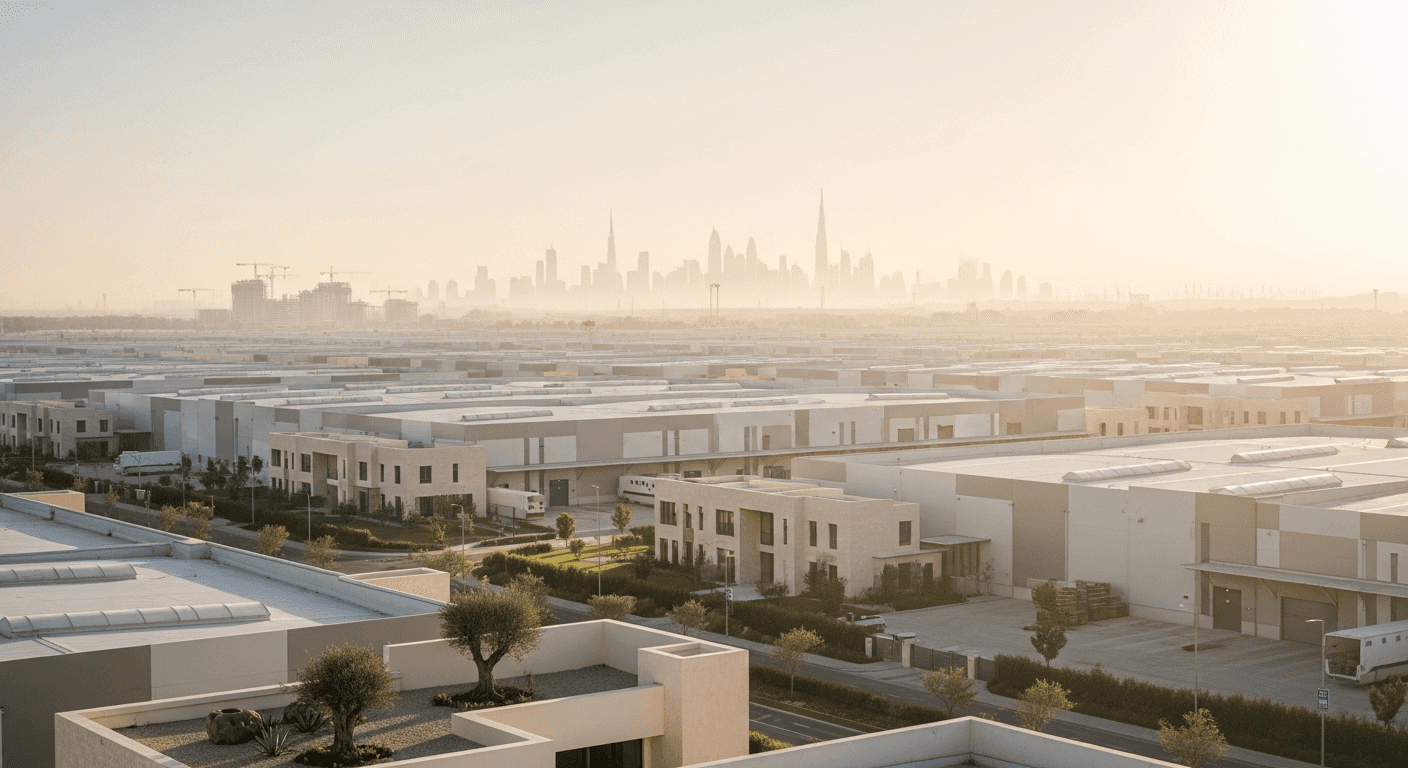
Beyond the Tower: Dubai's Industrial Real Estate Market
While residential gets the headlines, savvy investors are exploring Dubai's industrial and logistics sector. We break down the opportunity, risks, and real costs of investing in the backbone of the city's economy.

When international investors think of Dubai property, their minds drift to shimmering glass towers in Downtown Dubai or sprawling villas on the fronds of the Palm Jumeirah. This is the image Dubai has masterfully projected to the world. But in my experience, some of the most compelling and resilient investment stories are being written far from the beachfront, in the sprawling, meticulously planned industrial districts that form the true backbone of the emirate's economy. This is a market driven not by tourism or lifestyle, but by the hard numbers of global trade, container volumes, and the relentless growth of e-commerce.
For the right kind of investor — one with a long-term perspective and an appetite for due diligence, a Dubai industrial property investment offers a powerful alternative to the residential market. It provides portfolio diversification, longer lease terms, and, in many cases, superior net yields. This is a B2B asset class, where your tenants are corporations, not individuals, and the fundamentals are tied to global supply chains. At Gaia Living, we believe a truly informed investor needs to understand the entire spectrum of opportunities, and the industrial sector is a significant, if often overlooked, part of that picture. It's time to look beyond the tower.
Here's what we'll explore in this analysis:
- The fundamental drivers of Dubai's industrial property boom.
- A tour of the key industrial zones, from the established to the emerging.
- The different types of industrial assets: warehouses, light industrial units, and land.
- The real costs and returns: a detailed, line-by-line financial breakdown of an investment.
- A comprehensive due diligence checklist for prospective buyers.
- The future outlook and the trends shaping the market for the next decade.
The Unseen Engine of Dubai's Economy
Dubai’s economic miracle wasn't built on tourism alone. It was founded on a vision to become the preeminent trade and logistics hub connecting East and West. The Jebel Ali Port is consistently one of the world's top ten busiest container ports, and Al Maktoum International Airport (DWC) is designed to be the largest cargo airport on the planet. This strategic infrastructure is the bedrock upon which the demand for logistics real estate in Dubai is built. Every container that arrives, every shipment that is air-freighted, and every product sold online needs to be stored, sorted, managed, and dispatched from a physical building. These buildings — warehouses, fulfilment centres, and light industrial units, are the assets that underpin the entire system.
In recent years, this baseline demand has been supercharged by two powerful catalysts. The first is the UAE's national economic strategy. Initiatives like 'Operation 300bn' aim to more than double the industrial sector's contribution to the nation's GDP. This involves attracting advanced manufacturing, R&D, and high-tech industries, all of which require specialized industrial facilities. The government isn't just encouraging this; it's actively investing in the infrastructure and regulatory frameworks to make it happen. This top-down support creates a stable, long-term demand floor for industrial property.
The second, and perhaps more explosive, driver has been the e-commerce impact property trends have felt across the globe. The UAE has one of the highest internet penetration rates in the world, and consumer behaviour has decisively shifted online. This has created a voracious appetite for modern, efficient logistics spaces. It’s no longer about simple storage sheds. Today's tenants, from global e-commerce giants to local delivery startups, require sophisticated fulfilment centres with high ceilings for vertical racking, super-flat floors for robotic pickers, and strategic locations for last-mile delivery. This demand for quality has created a clear distinction in the market between older, obsolete stock and new, Grade-A facilities, which command premium rents and attract the best tenants.
For an investor, this landscape is fundamentally different from the residential market. Tenant covenants are stronger; a five-year lease with a multinational corporation is a different proposition from a one-year lease with an individual. The income stream is more predictable, and the landlord-tenant relationship is governed by commercial imperatives rather than personal circumstances. While the capital outlay can be higher, the stability and clarity of the business model are, for many, a significant draw. It’s an investment in the core mechanics of Dubai's commerce, a tangible stake in the city's role as a global economic hub.
Mapping the Opportunity: Key Industrial Zones
 Featured project
Location is paramount in all real estate, but in the industrial sector, it’s about connectivity and ecosystem, not just a prestigious address. An investor’s success hinges on choosing the right zone for their target tenant and asset type. Dubai's industrial landscape is a network of specialized hubs, each with its own unique characteristics.
At the heart of it all lies Jebel Ali Free Zone (JAFZA). As the original and largest free zone in the region, JAFZA is more than just a collection of warehouses; it’s a self-contained economic ecosystem. Its direct integration with the Jebel Ali Port gives tenants unparalleled sea-air logistics capabilities. The zone is home to thousands of companies, from global Fortune 500s to specialized traders, creating a dense network of suppliers and customers. For an investor, it's important to understand that most property within JAFZA is held on a long-leasehold basis from the authority, DP World. Direct freehold purchase by private investors is less common, but the rental rates and standards set in JAFZA serve as the benchmark for the entire Dubai market. It represents the absolute prime of industrial real estate.
If JAFZA is the established heart, then Dubai South is the future. This 145-square-kilometre master-planned city, which also hosts Expo City, is arguably the most ambitious logistics project in the world. Its core proposition is the Logistics Corridor, a dedicated, customs-bonded route that allows goods to be moved from the Jebel Ali seaport to Al Maktoum International Airport in a matter of hours. This integrated, multi-modal platform is a huge draw for global logistics operators. Within Dubai South, the Logistics District offers Grade-A warehousing and opportunities for freehold land purchase, allowing investors and corporations to develop build-to-suit facilities. As air cargo volumes grow and DWC continues its expansion, the strategic importance and value of assets in this zone are, in my view, set on a firm upward trajectory.
Another critical node is Dubai Investment Park (DIP). Developed by Dubai Investments, DIP is a unique, mature, mixed-use development that combines industrial, commercial, and residential components. Its key advantage is its strategic location between Sheikh Mohammed Bin Zayed Road and Emirates Road, providing excellent access to the entire UAE. Unlike the pure logistics focus of JAFZA or Dubai South, DIP caters to a broader range of businesses, including manufacturing, assembly, and companies that serve the local Dubai market. DIP was one of the first zones to offer freehold industrial land to investors, and as a result, it has a vibrant secondary market for warehouses and light industrial units. It offers a balance of excellent infrastructure and proximity to the city's commercial and residential centres, making it a perennially popular choice for both tenants and investors.
Beyond these titans, several specialized zones cater to specific industries. Dubai Production City and Dubai Studio City are hubs for media and printing. National Industries Park (NIP), adjacent to Jebel Ali, focuses on manufacturing and assembly. Al Quoz, while older and less structured, remains a critical hub for last-mile logistics, showrooms, and workshops due to its unbeatable proximity to the urban core of Dubai. Understanding the nuances of each zone — its governing authority, its permitted activities, its connectivity, and its tenant mix, is the first step in formulating a successful Dubai industrial property investment strategy.
Choosing Your Asset: Warehouses, LIUs, and Land
Once an investor has identified a target zone, the next decision is the specific type of asset to acquire. The term "industrial property" covers a wide range of buildings and land, each with its own risk-and-return profile and target market. Understanding these distinctions is crucial, as the wrong asset in the right location can still be a poor investment.
The most common asset class is the warehouse. These are the workhorses of the logistics sector, but not all warehouses are created equal. The market is increasingly stratified into different grades. A Grade-A warehouse, the most sought-after type, will feature high eaves (at least 10-12 metres) to allow for modern vertical racking systems, high floor-loading capacity (measured in kilonewtons per square metre) to support heavy goods and machinery, and excellent insulation. It will also have multiple dock-levellers for efficient loading and unloading of trucks, a substantial and well-integrated office component, and a state-of-the-art fire suppression system compliant with Dubai Civil Defence regulations. A Grade-B or C warehouse might be an older building with lower ceilings, fewer docks, or less power capacity. While cheaper to acquire, it may struggle to attract premium tenants and could face obsolescence. For investors, the specifications of the warehouse directly dictate its rental potential and long-term value.
A more accessible entry point into the market can be Light Industrial Units (LIUs). These are smaller units, often clustered together in business parks or specific zones within larger industrial areas like DIP or JAFZA One. Ranging from a few hundred to a few thousand square feet, LIUs are ideal for Small and Medium Enterprises (SMEs), workshops, showrooms, data centres, or small-scale assembly operations. The capital outlay is significantly lower than for a large standalone warehouse, and a multi-unit property can offer diversification of income. The management can be more intensive than a single-tenant warehouse, but the flexibility and lower price point make LIUs an attractive option for private investors looking to gain a foothold in the commercial property market.
“The glamour is in the penthouse, but the long-term, stable returns are often found in the warehouse.”
The final category is industrial land. This is the most capital-intensive and highest-risk/reward play, typically pursued by developers, large corporations, or sophisticated high-net-worth investors. The strategy here can be twofold. One is to acquire a freehold plot in a developing zone like Dubai South and hold it as a speculative investment, betting on capital appreciation as the area matures. The more common approach is to develop the land, either by building a speculative warehouse to lease or sell, or through a "build-to-suit" model. In a build-to-suit arrangement, the investor develops a facility to the precise specifications of a pre-committed tenant, who signs a very long-term lease (often 10-20 years). This provides a highly secure, inflation-hedged income stream, though it requires significant development expertise and capital. Understanding the nuances between leasing land from an authority versus buying freehold plots is critical, as it fundamentally changes the ownership structure and exit strategy.
The Numbers Don't Lie: A Realistic Cost and Return Analysis
Any serious investment discussion must move beyond concepts and into concrete numbers. The allure of commercial property Dubai returns is strong, but a clear-eyed assessment of all costs — upfront, operational, and hidden, is essential to accurately project net yield. Let's walk through a realistic, hypothetical scenario for a Dubai industrial property investment.
Imagine we're looking to acquire a 15-year-old, decent quality (Grade B) warehouse in a mature zone like Dubai Investment Park. The warehouse has a built-up area (BUA) of 10,000 sq. Ft. on a plot of 20,000 sq. Ft. The asking price is AED 5,000,000. Here's a breakdown of the upfront acquisition costs, which are often underestimated by first-time commercial investors:
- Purchase Price: AED 5,000,000
- Dubai Land Department (DLD) Transfer Fee: 4% of Purchase Price = AED 200,000
- Registration Trustee Fee: Approximately AED 4,200 (including VAT)
- Agency Fee: 2% of Purchase Price + 5% VAT = AED 105,000
- NOC Fee (to Master Developer): This can vary, but let's budget a typical AED 5,000
- Total Initial Investment: AED 5,309,200
This immediately shows that the real cost of acquisition is over 6% higher than the property's ticket price. This is the figure on which your returns must be calculated. Next, we must consider the ongoing operational costs that the landlord is responsible for. While tenants in commercial leases (known as 'triple net' leases in some markets) often cover utilities, maintenance, and their own contents insurance, the landlord bears the cost of owning the building itself.
- Annual Service Charges: These cover the maintenance of the common infrastructure in the industrial zone — roads, security, landscaping. Rates vary, but a reasonable estimate for DIP might be AED 2.50 per sq. Ft. on the plot area. For our 20,000 sq. Ft. plot, this amounts to AED 50,000 per year.
- Building Insurance: The landlord is responsible for insuring the structure. This might cost around 0.1% of the building's value, or roughly AED 5,000 per year.
- Maintenance Contingency: Even if the tenant handles routine upkeep, the landlord is responsible for major structural elements (roof, foundations). It's prudent to budget a small amount, say 0.5% of the annual rent, for unexpected repairs. If the rent is AED 400,000, that's AED 2,000 per year.
- Total Annual Landlord Costs: Approximately AED 57,000
Now for the income. Rental rates for a Grade B warehouse in this location might range from AED 35 to AED 45 per sq. Ft. per annum. Let's assume we secure a tenant at a solid rate of AED 40 per sq. Ft. on the 10,000 sq. Ft. BUA. This gives us a Gross Annual Rent of AED 400,000. To calculate our true return, we must find the Net Yield: (Gross Rent - Annual Costs) / Total Initial Investment. In our example: (AED 400,000 - AED 57,000) / AED 5,309,200 = AED 343,000 / AED 5,309,200 = 6.46%. This net yield is a far more realistic and useful figure than the 8% gross yield (AED 400k / AED 5M) that a seller might advertise. It's a solid, stable return, but it demonstrates the importance of doing your own math. In my opinion, any investor who doesn't build a similar spreadsheet is flying blind.
The Investor's Due Diligence Checklist
Given the complexity and capital involved, thorough due diligence is non-negotiable in industrial real estate. A pretty office and a fresh coat of paint can hide a multitude of expensive problems. Before signing any contract, a prudent investor — or their advisor, must conduct a deep-dive investigation. At Gaia Living, our commercial team uses a comprehensive checklist, and here are some of the most critical items.
First is the Physical & Technical Inspection. This goes far beyond a simple walkthrough. You need to verify the building's core specifications against the market standard and the tenant's needs. - Power Capacity: Is the connected load (in kilowatts) sufficient for industrial machinery or a temperature-controlled environment? Upgrading a building's power supply from DEWA can be exceptionally expensive and time-consuming. - Structural Integrity: Check the floor for cracks and confirm its loading capacity. Inspect the roof for any signs of leaks or damage. The roof is one of the most common and costly points of failure in an older warehouse. - Fire & Safety Systems: Is the sprinkler system, fire hose reels, and alarm panel fully compliant with the latest regulations from the Dubai Civil Defence? Non-compliance can render a building unusable until rectified at great expense. - Eaves Height: Measure the clear height from the floor to the lowest point of the roof structure. This determines the building's suitability for modern racking and its overall storage volume.
Second is the Legal & Title Verification. You must be absolutely certain about what you are buying and what restrictions apply. - Title Deed: Obtain a copy from the Dubai Land Department and verify the owner, plot number, and area are correct. The DLD's Dubai REST app provides a transparent way to do this. - Affection Plan: This crucial document from the master developer or municipality shows the plot boundaries, building setbacks, and any designated land use restrictions or utility easements. - Zoning & Permitted Use: Confirm that the property's designated use (e.g., 'light industrial', 'logistics and storage') aligns with your investment strategy and the activities of any potential tenant. - Freehold vs. Leasehold: Be crystal clear on the nature of the title. Is it a perpetual freehold right or a long-term lease from an authority that will eventually expire?
Third is Tenant & Lease Analysis, which is critical if you are buying a pre-leased asset. - Tenant Covenant Strength: Who is the tenant? A multinational logistics firm is a very different risk from a small, newly formed trading company. Research their business and financial health. - Lease Agreement: Scrutinize the lease document. What is the remaining term? Are there break clauses? What are the renewal terms and the mechanism for rent reviews? Is the rent in line with the current market rate? - Payment History: Ask for a statement of account to confirm the tenant has a history of paying rent on time and in full.
Finally, scrutinize the Financials. Ask the seller for the service charge history for the past three years to check for any sharp increases or special assessments, which could indicate poor management or upcoming major works in the community. A thorough, systematic approach to due diligence is the best way to protect your capital and ensure your warehouse market insights translate into a profitable venture.
The E-commerce Tsunami: A Permanent Shift
It is impossible to overstate the e-commerce impact on property demand in the logistics sector. This is not a cyclical trend; it is a permanent structural shift in how goods are bought and sold, and it has fundamentally rewritten the rulebook for industrial real estate. For investors, understanding the nuances of this shift is key to identifying the most valuable and future-proof assets. The demand is no longer just for big boxes on the edge of town; it is for a sophisticated, multi-layered network of facilities designed for speed and efficiency.
The most visible change is the demand for massive, modern fulfilment centres. Global players like Amazon and local champions like Noon have leased or built vast, technologically advanced warehouses, particularly in hubs like Dubai South and Dubai Logistics City. These facilities are characterized by their immense scale, high ceilings (often 15 metres or more), and integration of automation and robotics. While developing or acquiring such an asset is the preserve of institutional investors, their presence has a powerful ripple effect. They attract a cluster of smaller 3PL (third-party logistics) companies that service them, creating a vibrant ecosystem and driving up rental values for all well-specified warehouses in the vicinity.
Perhaps the most interesting niche created by e-commerce is the "last-mile" delivery hub. Consumer expectations for same-day or even two-hour delivery have created a need for smaller logistics pockets located deep within the urban fabric, close to residential population centres. This has breathed new life into older, more central industrial areas like Al Quoz and Ras Al Khor. While the warehouses here may not have the specs of a new build in Dubai South, their location is their gold. Companies are willing to pay a premium for a base from which they can quickly dispatch goods to customers in Dubai Marina or Arabian Ranches. For an investor, acquiring a smaller, well-located warehouse in these areas can be a very shrewd play on the last-mile delivery boom.
Another specialized and highly profitable sub-sector is cold storage. The explosion in online grocery shopping and food delivery services has led to a critical shortage of temperature-controlled warehousing. These facilities are more complex and expensive to build and operate than standard warehouses, requiring heavy-duty insulation, powerful cooling plants, and significant power capacity. However, they command substantially higher rental rates, often 50-100% more than an equivalent ambient warehouse. The tenants are typically major supermarkets, food distributors, and pharmaceutical companies who sign long leases. This combination of high barriers to entry and strong, non-discretionary demand makes cold storage a particularly attractive asset class for investors with the right expertise and capital.
The evolution driven by e-commerce means investors should no longer think of warehouses as generic sheds. The future of Dubai industrial property investment lies in identifying the specific needs of the modern supply chain — be it large-scale fulfilment, rapid last-mile delivery, or specialized cold storage, and acquiring the assets that cater directly to that demand.
My Verdict: An Unfashionable but Powerful Investment
So, after weighing the drivers, the costs, and the risks, where do I stand on industrial real estate as an investment class in Dubai? In my view, it represents one of the most intelligent, if unfashionable, opportunities in the market today. It lacks the glamour of a penthouse with a sea view, but it offers something many investors crave even more: the potential for stable, long-term income underpinned by the fundamental economic activity of the city.
The case for it is compelling. The demand drivers are structural, not cyclical. Dubai's commitment to being a global trade hub and the irreversible shift to e-commerce provide a powerful, long-term tailwind. The lease structures are attractive, with typical terms of 3-5 years or longer providing far greater income security than a standard one-year residential tenancy. When analyzed correctly, the net yields, in the 6-7.5% range for good assets, are highly competitive and often superior to what can be achieved in the residential market after accounting for service charges and voids. It also offers excellent portfolio diversification for investors who are already heavily weighted in residential property.
However, I must stress that this is not a passive investment. The barriers to entry are higher, both in terms of capital and knowledge. The due diligence process is more complex and technical. The risks, particularly tenant default and building obsolescence, are significant and need to be actively managed. This is not a market for speculators looking for a quick flip; it is a market for serious, well-capitalized investors with a five-to-ten-year horizon who are willing to do their homework.
For that type of investor, the industrial and logistics sector offers a chance to own a piece of the essential infrastructure that makes Dubai work. It's an investment in the flow of goods, the growth of commerce, and the future of the emirate's economy. While the headlines will continue to be dominated by the latest luxury tower launch, the quiet, consistent performance of a well-chosen warehouse in Dubai Investment Park or Dubai South may well be the smarter long-term play. It's a complex market, but for those who navigate it successfully, the rewards are substantial. At Gaia Living, we have the specialized expertise to guide investors through this process, from initial analysis to acquisition and management. If you are looking to expand your portfolio beyond the residential, we believe the industrial sector deserves your full attention.
## Sources - Dubai Land Department (DLD): dubailand.gov.ae - Dubai's Open Data Portal (Dubai Pulse): dubaipulse.gov.ae - Central Bank of the UAE (CBUAE): centralbank.ae - UAE Government Portal: u.ae
Questions, answered
- What is a realistic net yield for a Dubai warehouse?
- A realistic net yield for a good quality, well-located warehouse in Dubai typically ranges from 6% to 7.5%. This is after accounting for service charges and other landlord costs, distinguishing it from higher gross yield figures that are often quoted.
- Can foreigners buy industrial property in Dubai?
- Yes, foreign investors can purchase industrial property on a freehold basis in designated areas. Key zones offering this include Dubai Investment Park and parts of Dubai South, allowing for 100% foreign ownership of the asset.
- What is the typical minimum investment for a small warehouse in Dubai?
- The entry point for a smaller, older light industrial unit or warehouse can start around AED 1.5 million to AED 2.5 million. For a modern, mid-sized warehouse in a prime location, investors should expect a capital outlay starting from AED 5 million and upwards.
- How long are typical warehouse leases in Dubai?
- Warehouse leases in Dubai are significantly longer than residential contracts, providing stable income for landlords. Leases commonly range from 3 to 5 years, with large corporate tenants or custom-built facilities often signing for 10 years or more.
- Is it better to invest in a free zone or a mainland industrial area?
- The choice depends on your investment goals. Free zones like JAFZA or Dubai South attract global companies with 100% ownership and tax incentives, offering a premium tenant base. Mainland areas like Al Quoz cater more to the local market, offering different dynamics and tenant profiles.
- What are the main risks of investing in Dubai's industrial real estate?
- The main risks include economic sensitivity tied to trade volumes, the potential for a major tenant to default, and asset obsolescence as logistics technology evolves. Thorough due diligence on tenant quality and building specifications is critical to mitigate these risks.

Omar tracks the announcements that move the market — new launches, regulation, mega-projects, and developer moves — and tells you what they actually mean for buyers.
Related stories

Beyond the Gates: Dubai's Boutique Villa Sanctuaries
I'm exploring the small, exclusive villa communities that offer a real sense of place, moving beyond the well-trodden path of Dubai's famous megaprojects to find homes with genuine character.

Off-Plan vs Ready: The Dubai Investor's Guide
A detailed comparison for apartment investors in Dubai, weighing the capital appreciation potential of off-plan against the immediate returns of ready properties.

Clearing Disputes for a Smooth Dubai Sale
Unseen property disputes or financial encumbrances can derail your Dubai property sale. I'll share my strategic playbook for identifying and resolving these issues before they cost you time and money.
Echoes, in your inbox
One thoughtful email a month. Market insight, new launches, no spam.