

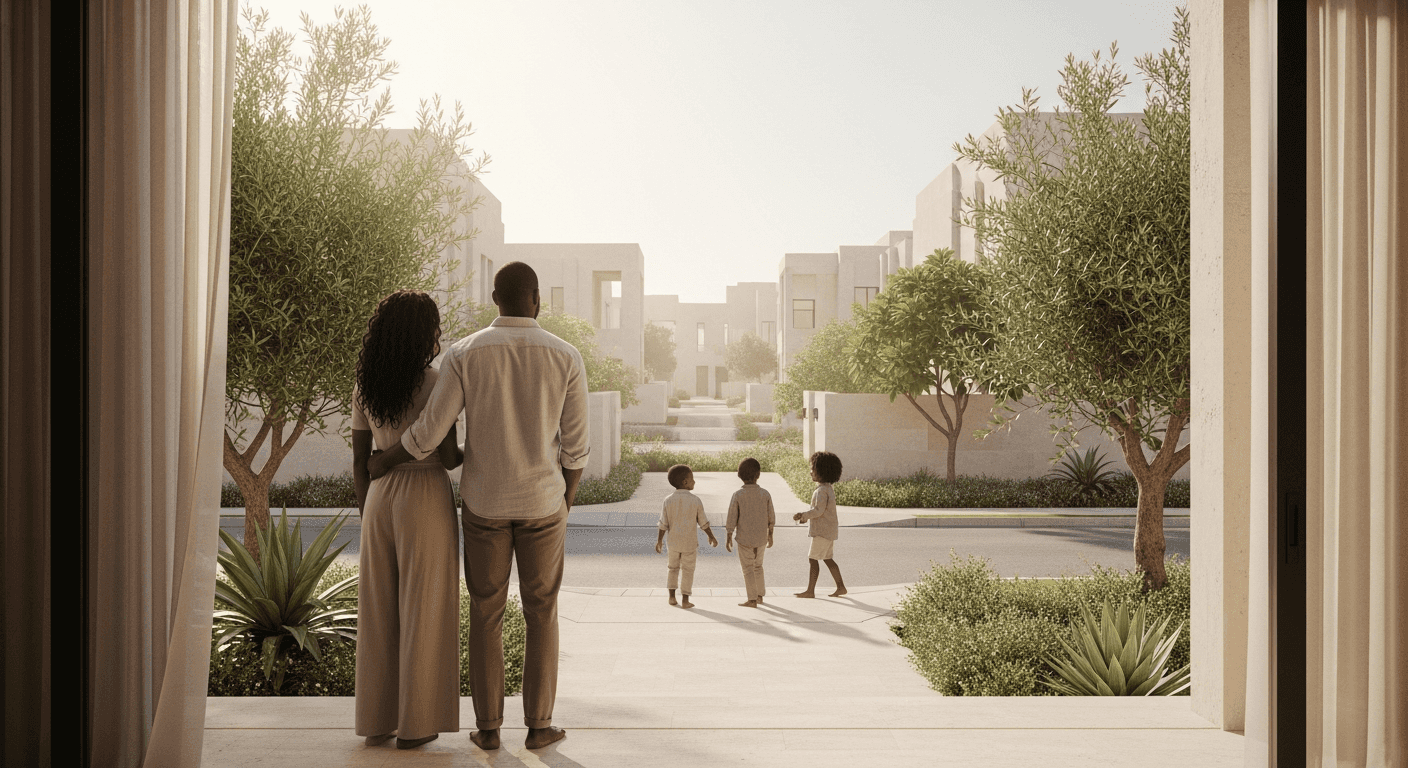
Beyond the Gate: A Parent’s Guide to Family Safety in Dubai
For families in Dubai, true peace of mind goes beyond a security gate. As a communities specialist, I'll show you what really makes a villa community safe for your children.

As a parent and a communities specialist at Gaia Living, the question of safety is more than a professional concern; it’s personal. When clients ask me, “Where is the safest place to raise my family in Dubai?” I know they’re asking about more than just crime statistics. They’re asking for that intangible feeling of peace that comes from knowing your children can ride their bikes down the street, that the walk home from a friend’s house is secure, and that the community itself is designed with their well-being in mind. The baseline of safety in Dubai is already one of the highest in the world, but achieving genuine `peace of mind villa living` requires a deeper look beyond the boom gate.
Here's what we'll explore in this guide:
- The standard security features you can expect in any gated community.
- The gold standard: communities where security is paramount.
- The family favourites that balance security with a vibrant lifestyle.
- How to assess safety in newer, emerging developments.
- The crucial role of community design in creating `child-friendly security measures`.
- The 'soft' infrastructure of safety: why neighbours and schools matter.
- A real-world cost breakdown for securing a family villa.
- My verdict on where families can find the best balance.
The Baseline: Deconstructing Gated Community Security in Dubai
When we talk about `secure villa communities Dubai`, the term 'gated community' is the starting point. It's a fundamental offering from nearly every master developer in the city, from Emaar Properties to Nakheel and Damac. But what does this label actually guarantee? In my experience, there’s a consistent baseline of features that you can expect. At the most fundamental level, you have controlled access. This means a physical barrier — a gatehouse with a boom gate, staffed 24/7 by security personnel. Their job is to manage the flow of traffic, verify visitors, and serve as the first point of contact in any incident.
Resident access is typically streamlined through RFID tags on cars, access cards, or increasingly, mobile phone apps that can generate temporary passes for guests. This creates a clear record of who is entering and exiting the community. Complementing the guards is a network of CCTV cameras, monitored from a central control room. These are strategically placed at entrances, along main roads, and in common areas like parks and pools. The entire community is also enclosed by a perimeter wall or fence, which acts as a physical deterrent and clearly defines the community's boundary. These elements form the backbone of `gated community security features` across Dubai.
These services are not free; they are a significant component of the annual service charges paid by every homeowner to the Owners Association Management company. These fees, regulated by Dubai's Real Estate Regulatory Agency (RERA), cover the costs of security staff, technology maintenance, and general upkeep of all common areas. For most villa communities, you can expect these charges to range from AED 3 to AED 6 per square foot of your property's built-up area (BUA). So, for a 4,000 sq. Ft. villa, the annual cost for these services would be between AED 12,000 and AED 24,000. It's a tangible investment in the collective security and ambience of the neighbourhood.
However, it's important to understand that this is just the hardware of security. The effectiveness of these systems — the 'software', depends entirely on the training of the guards, the responsiveness of the management company, and the active participation of residents. A sleepy guard, a broken camera, or a culture of tailgating through the gates can undermine the entire setup. This is why, when I assess a community, I look beyond the checklist of features and observe how they function in the real world. Are the guards alert and professional? Are the common areas well-maintained and lit? This operational excellence is what separates a truly secure community from one that simply has a gate.
The Gold Standard: Where Security is a Foundational Pillar
 Featured project
While most communities offer a solid baseline, a select few operate on a completely different level. These are the neighbourhoods where security is not just a feature but a core tenet of their existence, woven into the very fabric of the master plan. These are the enclaves designed for those who require the utmost privacy and discretion, where the price of entry buys an unparalleled level of seclusion and protection. The undisputed leader in this category is Emirates Hills, an Emaar development that has long been the benchmark for ultra-luxury living in Dubai. Security here is multi-layered and uncompromising.
In Emirates Hills, it’s not just about a single gatehouse. The community is divided into several sectors, each with its own controlled access points. Mobile security patrols are a constant, visible presence, and the entire area is blanketed by a sophisticated surveillance system. The security protocols are rigorous; every visitor is called and verified by the resident before entry is granted, without exception. This isn't the kind of place you can just show up to for a look around. The result is an environment of near-total privacy. This level of fortification is designed for a specific clientele — captains of industry, high-profile individuals, and families who prioritise absolute seclusion. The grand villas are often set back on large plots, further enhancing this sense of a private sanctuary.
Another community that exemplifies this top tier of security is Jumeirah Golf Estates. While its primary identity is tied to its world-class golf courses, its security infrastructure is equally impressive. The sheer scale of JGE, with its distinct 'Earth' and 'Fire' courses and multiple residential clusters, necessitates a robust and decentralized security model. Each cluster, or small neighbourhood, within the larger community often has its own secondary access controls. This creates small, intimate pockets where residents feel a heightened sense of security and familiarity. The landscaping itself is part of the security design, using natural barriers and carefully planned sightlines to enhance surveillance and deter unauthorized access. The internal road network is designed to be calm and residential, discouraging through-traffic and creating a tranquil atmosphere.
Living in these gold-standard communities comes at a premium, not just in property prices but also in service charges. The cost of maintaining such a comprehensive security apparatus is substantial, and homeowners should expect annual fees at the higher end of the spectrum, potentially AED 6 to AED 8 per sq. Ft. or more. For families considering these areas, the investment buys more than just safety from external threats; it buys a level of privacy and exclusivity that allows for a very particular lifestyle. It's an environment where children can have the run of a vast private estate, and public visibility is kept to an absolute minimum. It’s the fortress model of `family safety Dubai villas`, executed to perfection.
The Family Favourites: Balancing Security, Lifestyle, and Community
For the vast majority of families, the fortress-like security of an Emirates Hills is neither necessary nor, in some ways, desirable. The sweet spot for most lies in communities that masterfully blend robust security with a vibrant, open, and child-centric lifestyle. This is where developers like Emaar truly shine, having perfected a model that has become the blueprint for family life in Dubai. The quintessential example, and a long-standing personal favourite of mine, is Arabian Ranches. It was one of the original master-planned suburban communities, and it set the standard for what a family neighbourhood could be.
What Arabian Ranches gets so right is that its security feels integrated, not imposed. Yes, it has the requisite 24/7 guarded gates and perimeter walls. But the real sense of safety comes from within. The community is designed around a central spine of parks, pools, and pathways. This layout encourages residents to be out and about, creating what urban planners call 'eyes on the street'. When you have parents pushing strollers, kids cycling to the community centre, and neighbours walking their dogs, you create a powerful, informal surveillance network. People know each other. They recognise strange cars and unfamiliar faces. This social fabric is, in my opinion, as powerful a security feature as any CCTV camera. The community has matured beautifully, with established routines — the morning school run, the afternoon park gatherings, that give it a predictable and comforting rhythm.
Taking this successful model and updating it for a new generation is Dubai Hills Estate, another Emaar masterpiece. I often describe it to clients as 'Arabian Ranches 2.0'. It takes all the winning elements — gated security, premium amenities, a strong community focus, and elevates them with a more contemporary design and even more ambitious green spaces. The Dubai Hills Park, an 180,000 square metre green lung at the heart of the community, is a masterstroke. It's a safe, contained space where families can gather, play, and connect. The network of shaded cycling and jogging tracks that weaves through the entire development is another key element of its `child-friendly security measures`. It means kids can have a degree of freedom and independence, travelling safely between their homes and the parks without ever needing to cross a major road.
Other communities like The Meadows, also by Emaar, fit this mould perfectly, offering serene lake views and a well-established community feel. What defines these family favourites is this deliberate balance. The security is top-notch, but it serves as a backdrop to a lively community, not a barrier to it. It’s about creating an environment where children can experience a sense of freedom and parents can have peace of mind. The design encourages interaction, the amenities foster connection, and the management ensures the core security infrastructure is flawless. This combination is the key to creating the best `secure villa communities Dubai` has to offer for the modern family.
Emerging Communities: Assessing Security in Newer Developments
As Dubai continues to expand, new villa communities are constantly launching and handing over, offering modern designs and attractive payment plans. For families exploring these options, from master-planned areas in Dubai South to projects by developers like Damac in Damac Hills and Damac Hills II, it's important to apply a specific lens when assessing their long-term security potential. Buying into a new or off-plan community is an act of faith in the developer's vision, and security is a huge part of that.
One of the first things I advise clients to do is to scrutinize the master plan, not just the individual villa layout. Look for the same design principles that make established communities successful. Where are the parks and play areas located? Are there safe, dedicated pedestrian and cycling paths connecting homes to these amenities? How is traffic being managed? Look for designs that prioritize slow internal roads and limit through-traffic. A well-designed master plan will inherently be safer. It's also critical to understand the phasing of the project. If you're buying into phase one, you need to be prepared for several years of nearby construction, which inevitably means a constant flow of contractors and heavy vehicles. Ask the developer direct questions: How will construction traffic be segregated from residential areas? What security protocols will be in place to manage site access?
“The most telling sign of a future-proof secure community isn't the height of its walls, but the width of its sidewalks and the number of parks on its master plan.”
A developer's track record is your best guide. If a developer has a portfolio of established, well-managed communities, it's a strong indicator that they understand the operational complexities of running a secure and pleasant neighbourhood. Look at their older projects. Are they still well-maintained? Is the security still diligent? This history provides more assurance than any marketing brochure. When a community is in its initial handover phase, there can be a period of adjustment. The full security team may not be in place, landscaping might be incomplete, and the resident population will be low. This can feel unsettling for the first families to move in. It's a trade-off for getting a brand-new home, and something parents need to be mentally prepared for.
In my experience, the first year in a new community is the most telling. This is when the Owners Association is formed and the first service charge budgets are set. It’s crucial for early residents to be actively involved, to ensure that security is properly funded and prioritized from day one. Attending these initial meetings and voicing concerns can shape the direction of the community for years to come. Ultimately, investing in an emerging community requires due diligence and a bit of patience. The promise of modern amenities and a fresh start is appealing, but ensuring it evolves into a truly secure family haven depends on the developer's competence and the early residents' engagement.
Beyond the Barrier: How Community Design Creates Child-Friendly Security
After years of walking through every major villa community in Dubai, I’ve come to a firm conclusion: the most effective `child-friendly security measures` have little to do with technology and everything to do with intelligent design. A guard and a gate provide a hard perimeter, but the feeling of safety within those walls is generated by the thoughtful layout of streets, homes, and public spaces. This is the concept of 'natural surveillance', a term that simply means a place feels safer when it’s filled with people and designed so that homes and pathways overlook one another.
Consider the difference between two villa styles. One features high compound walls, a garage that opens directly onto the street, and few front-facing windows. It’s a private fortress. While it feels secure in isolation, it contributes nothing to the safety of the street it sits on. It creates a sterile, unwatched environment. Now, contrast that with a villa that has a small, open front garden, a front porch, and large living room windows facing the street. The family inside can see their kids playing on the sidewalk. Their neighbours can see them too. This simple architectural choice turns residents into a passive security force. Communities that encourage this style, like the newer clusters in Arabian Ranches or parts of Dubai Hills, inherently feel safer and more neighbourly.
This principle extends to the community's macro-layout. The best family communities are highly permeable for pedestrians but impermeable for cars. They achieve this with extensive networks of dedicated walking and cycling paths that are completely separate from roads. They are well-lit, beautifully landscaped, and connect homes directly to parks, pools, and community retail. This design allows a ten-year-old to have a measure of independence — to cycle to a friend's house or the local park, in a completely safe and controlled environment. The alternative is a community where every trip requires a car, and sidewalks are an afterthought, forcing kids to play in driveways or on quiet cul-de-sacs. The former is a community designed for families; the latter is a subdivision designed for cars.
The placement and design of parks is another critical factor. A single, large, central park, like the one in Dubai Hills, acts as a community hub. It's a destination. Because it's always busy, it's always being watched by dozens of other parents. This collective supervision is incredibly powerful. Smaller, scattered 'pocket parks' can also be effective, provided they are clearly visible from the surrounding homes. The worst design is a playground tucked away in a forgotten corner of the community, hidden by landscaping. These isolated spots can become magnets for anti-social behaviour because they lack natural surveillance. When you tour a community, don't just count the parks on the map; stand in them and ask yourself, "Who can see me right now?" The answer will tell you a lot about the true safety of the space.
The 'Soft' Infrastructure of Safety: Schools, Playgrounds, and Neighbours
True `peace of mind villa living` is ultimately delivered not by concrete and cameras, but by people. The 'soft infrastructure' of a community — the social connections, shared routines, and collective sense of ownership, is the final and most important layer of family safety. A strong community is a self-policing one, where neighbours look out for one another not because of a formal neighbourhood watch program, but because they genuinely know and care for each other. This is the intangible quality that I always look for.
The presence of a good school within or adjacent to the community is a powerful catalyst for this social bonding. The daily ritual of the school run, whether by car, by bike, or on foot, is the heartbeat of a family community. It’s where parents connect while waiting at the school gate, sharing news and arranging playdates. It creates an instant network of families who are on the same schedule and navigating the same life stage. Communities like Dubai Hills Estate, with its multiple high-quality schools right on-site, or Arabian Ranches, with its own dedicated school and community centre, are prime examples of this synergy. The school becomes the social anchor for the entire neighbourhood.
Playgrounds, community pools, and local cafes serve the same function. These are the 'third places' — the spaces outside of home and work, where informal social life unfolds. I’ve seen more friendships forged over a coffee at the Arabian Ranches retail centre or on the sidelines of a kids' football practice in The Meadows than anywhere else. These interactions are the building blocks of trust. When you know the family three doors down, you're more likely to notice if their garage door is left open late at night or if a strange car is parked outside their home for too long. You feel comfortable asking them to keep an eye on your house when you travel. This web of casual, reciprocal support is invaluable.
This is why, when advising families, I urge them to think about their lifestyle, not just their house. Do you want to be able to walk for a morning coffee? Do you want your kids to have a choice of five different playgrounds within a 10-minute bike ride? These lifestyle amenities are not just 'nice-to-haves'; they are the machinery of community-building. A community that is designed to bring people together is a community that will, over time, become safer. The shared experience of raising children in the same place creates a powerful bond and a collective investment in maintaining a safe, nurturing environment for everyone.
The Unseen Costs: Budgeting for Security and Peace of Mind
Choosing a secure family home is an emotional decision, but it's grounded in financial reality. It’s crucial for buyers to understand not only the headline purchase price but also the full spectrum of upfront and recurring costs associated with owning a villa in one of these communities. At Gaia Living, we believe in full transparency, so let’s break down the real costs of securing a family home, using a hypothetical 4-bedroom villa in a sought-after community like Dubai Hills Estate as an example.
Let's assume a purchase price of AED 6,500,000. The mandatory government fees are the first major cost. The Dubai Land Department (DLD) transfer fee is a flat 4% of the property value, a legal requirement stipulated on the DLD's official website. There are also smaller administrative fees associated with the title deed registration. If you're using a mortgage — as most families do, you'll also have fees payable to the bank and the DLD for registering the mortgage. Here is a realistic, line-by-line breakdown of the upfront costs:
- Purchase Price: AED 6,500,000
- Dubai Land Department (DLD) Fee (4%): AED 260,000
- DLD Admin Fees: approximately AED 4,200
- Real Estate Agency Fee (2% + 5% VAT): AED 136,500
- Mortgage Registration Fee (0.25% of loan amount): AED 13,000 (assuming an 80% loan of AED 5.2M)
- Bank Mortgage Arrangement & Valuation Fees: approximately AED 8,250
- Developer No Objection Certificate (NOC) Fee: approximately AED 5,250 (for Emaar)
- Total Estimated Upfront Cost: AED 6,927,200
This shows that you need to budget nearly 7% on top of the purchase price for the transaction itself. But the costs don't stop there. The annual service charges are the recurring investment in your community's safety and upkeep. For our 4,000 sq. Ft. example villa in Dubai Hills, with a service charge rate of around AED 4.50 per sq. Ft., the annual bill would be AED 18,000. This covers security, common area landscaping, pool maintenance, street lighting, and general administration. In a more premium community like Jumeirah Golf Estates, that rate might be closer to AED 6 per sq. Ft. (AED 24,000 annually), and in Emirates Hills, it could be higher still. These figures are not arbitrary; they are proposed by the Owners Association Management company and approved by RERA, and owners can view the breakdown using the Dubai REST app.
When budgeting, families must factor in these recurring costs as they are a permanent part of the financial commitment. While no one enjoys paying fees, it's essential to see them as an investment in the very lifestyle and security you're buying into. A community with unrealistically low service charges might seem attractive initially, but it's often a red flag. It could mean that essential services, including security, are being underfunded, which will inevitably lead to a decline in the community's standards and, ultimately, its property values. Paying a fair price for excellent management and robust security is one of the smartest investments a homeowner can make.
My Verdict: Where Should Your Family Put Down Roots?
After weighing all the factors — the hardware of gates and guards, the software of community design, and the intangible heart of a neighbourhood, where does a family find the best balance of safety, lifestyle, and value in Dubai? The answer, of course, is personal and depends on your budget and priorities. However, through my experience at Gaia Living helping countless families find their home, a clear picture emerges.
For those for whom budget is no object and absolute privacy is the primary goal, the gold-standard communities like Emirates Hills remain in a league of their own. They offer a level of seclusion and tailored security that is unmatched. But for the majority of families, I believe the extraordinary cost and the somewhat isolated nature of these enclaves are not the ideal choice. The true sweet spot lies in the 'Family Favourites' category — the master-planned communities that have been explicitly designed to balance top-tier security with a rich, interactive, and child-friendly environment.
In my professional and personal opinion, communities like Dubai Hills Estate and Arabian Ranches represent the pinnacle of this balanced approach. They provide all the robust `gated community security features` you would expect, but they don't stop there. They invest heavily in the 'soft' infrastructure — the parks, the pathways, the schools, the community centres, that foster connection and create that invaluable 'eyes on the street' effect. They are not just safe; they feel safe. They are designed to give children a precious sense of freedom while giving parents an equally precious sense of calm. They understand that a child on a bicycle is a sign of a healthy, secure community.
The best investment in family safety isn't necessarily the community with the highest walls or the most guards, but the one with the most active parks, the most connected pathways, and the strongest sense of neighbourly connection. True security is a byproduct of a well-designed, vibrant community.
Ultimately, I encourage every family to experience these communities firsthand. Don't just drive through. Park the car. Walk the pathways on a weekday afternoon. Visit the parks on a Saturday morning. See if the rhythm of the community matches the life you envision for your family. The right community is out there, and our team at Gaia Living is here to help you find it. It's a place where the feeling of coming home is synonymous with the feeling of being safe.
Sources
- Dubai Land Department (DLD): https://dubailand.gov.ae
- Dubai REST (Real Estate Self Transaction) App: https://dubairest.gov.ae
- UAE Government Portal: https://u.ae
Questions, answered
- What are the basic security features in a Dubai gated community?
- Most gated communities in Dubai include 24/7 security personnel at access points, perimeter fencing or walls, CCTV surveillance in common areas, and controlled entry systems, often using access cards or mobile apps for residents.
- Are newer villa communities in Dubai as secure as established ones?
- Newer communities often have more modern security tech, but established ones have mature systems and a community culture of watchfulness. During the initial handover phase of a new community, there can be a lot of contractor traffic, so it's wise to assess the developer's plan for managing this.
- How much do security and community maintenance fees typically cost for a villa?
- These are covered by annual service charges, which vary by community. For family-oriented communities like Dubai Hills or Arabian Ranches, expect to pay around AED 4-6 per square foot of your villa's built-up area annually. In ultra-premium areas, this can be higher.
- Which communities are considered the gold standard for family safety in Dubai?
- Communities like Arabian Ranches and Dubai Hills Estate are benchmarks for balancing robust security with a family-friendly lifestyle. For ultimate privacy and layered security, Emirates Hills is in a class of its own, though at a much higher price point.
- Besides guards and gates, what makes a community feel safe for children?
- Community design is crucial. Features like well-lit pedestrian pathways, large central parks, low traffic speeds, and villas with sightlines to play areas create 'natural surveillance'. When kids are visible and neighbours are present, it fosters a much safer environment.
- Can I check the official service charges for a community before I buy?
- Yes, you can. The Dubai Land Department's Dubai REST app allows property owners to see approved service charge breakdowns for their community. As a buyer, you can ask the seller to provide the current service charge index for the property you're interested in.

Sophia profiles Dubai's villa communities — schools, commute times, green space, and the intangible feel of a neighbourhood. She writes for families putting down roots.
Related stories
Calculating ROI on Dubai Rental Upgrades
As a landlord in Dubai, you can't just follow trends. I'll show you how to calculate the precise ROI of minor property upgrades to genuinely increase your rental yield.
Off-Plan vs Ready: The Real Cost of Capital
I analyse the fundamental trade-off every Dubai investor faces: the lure of off-plan capital growth versus the security of immediate rental income from a ready property.
Beyond the Gates: Dubai's Boutique Villa Sanctuaries
I'm exploring the small, exclusive villa communities that offer a real sense of place, moving beyond the well-trodden path of Dubai's famous megaprojects to find homes with genuine character.
Echoes, in your inbox
One thoughtful email a month. Market insight, new launches, no spam.