

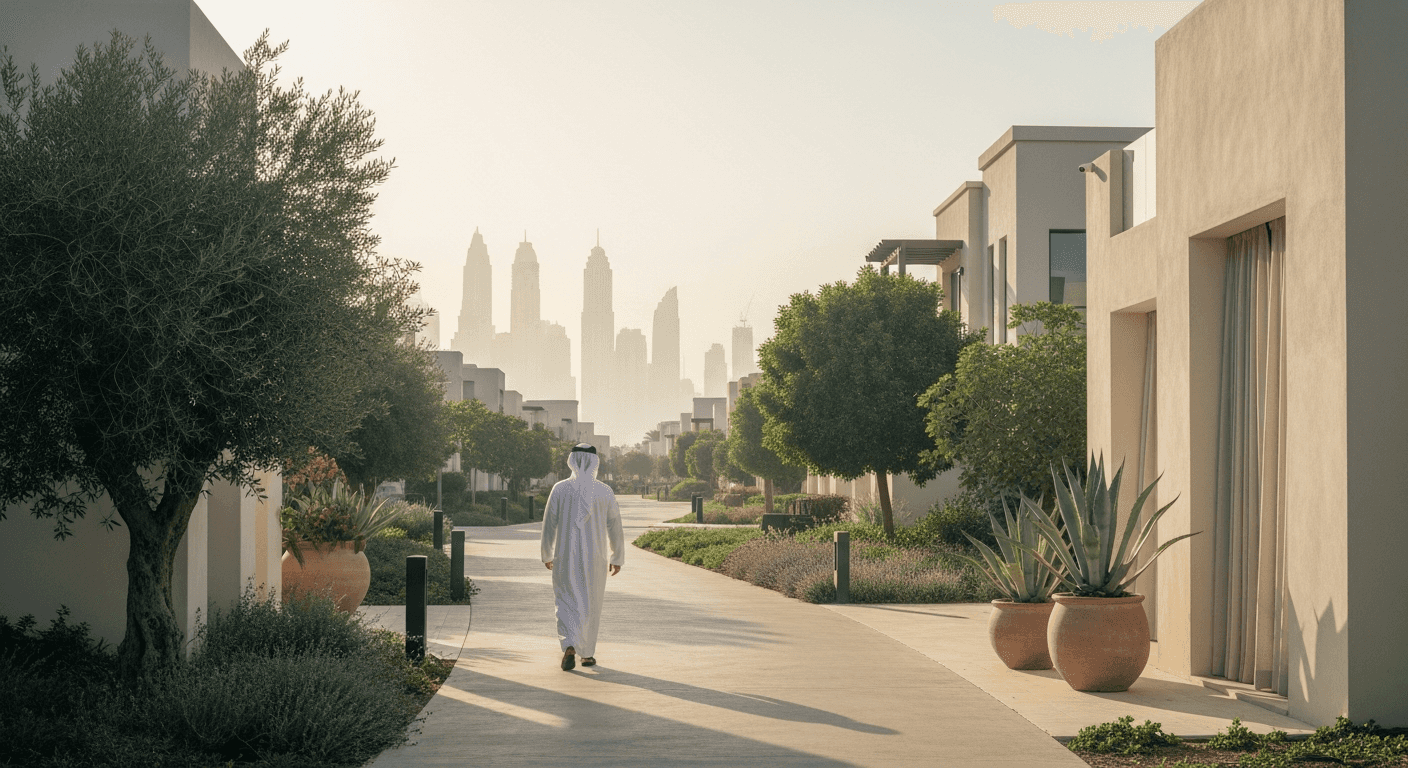
Beyond the Car: Dubai’s Walkable Villa Havens
Discover the Dubai villa communities where you can leave the car behind. We explore the neighbourhoods designed for walking, cycling, and genuine connection, with shops and parks right on your doorstep.

For years, the dream of a Dubai villa came with an unspoken condition: you would live in your car. The sprawling home, the private garden, the sense of space — it was all predicated on driving for every single errand. But a quiet revolution has been reshaping Dubai's suburbs, proving that villa living and walkability are not mutually exclusive.
Here’s what we'll explore in this guide:
- The shift away from car-centric design in Dubai's master planning.
- Arabian Ranches: The original community that wrote the blueprint for walkability.
- Dubai Hills Estate: The modern standard-bearer for integrated living.
- Town Square: How affordability and pedestrian-first design can coexist.
- Other strong contenders for *bike-friendly neighbourhoods Dubai*.
- The key features that define a truly walkable community.
- A detailed breakdown of the purchase costs and ongoing fees.
- The realistic trade-offs and my final verdict on the best communities for a 'car-lite' life.
The Myth of the Car-Centric Villa
When I first began my career in Dubai real estate, the villa communities we showed clients were beautiful, but isolated. They were islands of residential calm, requiring a car journey to fetch a bottle of milk, meet a friend for coffee, or take the children to a playground. This was the accepted model. The trade-off for space and privacy was a reliance on road networks and a lifestyle segmented by car trips. This perception became so entrenched that for many, the phrase *walkable villa communities Dubai* felt like a contradiction in terms.
However, this stereotype is now outdated. Over the past decade, and accelerating rapidly since 2020, there has been a fundamental shift in both developer philosophy and buyer demand. The most successful new communities are being designed around people, not just cars. Influenced by global urbanism trends like the '15-minute city' — where most daily necessities and services can be reached by a 15-minute walk or bike ride, developers are creating holistic ecosystems. It's a move from building housing estates to crafting neighbourhoods.
Master developers like Emaar Properties, Nakheel, and Nshama have recognised that today’s families crave connection, convenience, and a healthier lifestyle. The post-pandemic world amplified this desire exponentially. Suddenly, the value of a local park you could walk to, a running track outside your door, and a friendly café around the corner became immeasurable. At Gaia Living, we saw this shift directly in client briefs. Requests for “a big garden” were joined by “walking distance to a supermarket” and “safe cycle paths for the kids.” This isn't just a niche preference; it has become a primary driver of value and desirability in the family home market.
This evolution is visible on the ground. It's in the wide, shaded pavements, the integrated retail centres that feel like town squares rather than strip malls, and the green corridors that weave between villa clusters, connecting them to shared amenities. The goal is to create an environment where the car is a choice, not a necessity, for daily life. This change marks the maturation of Dubai’s property market, moving beyond sheer scale and ambition to focus on the human experience of living here.
The Original Blueprint: Arabian Ranches
 Featured project
Long before 'walkability' became a marketing buzzword, there was Arabian Ranches. Launched by Emaar in the early 2000s, it remains, in my opinion, the foundational case study for successful suburban master planning in Dubai. When we talk about established, mature communities where the landscaping has grown in and the pedestrian pathways feel organic, the original Ranches I is the benchmark. It demonstrated that you could build a large-scale villa development that fostered a genuine, village-like atmosphere.
The genius of Arabian Ranches lies in its simple but effective structure. Rather than being a monotonous grid of villas, it was designed with a central spine of community assets. The Arabian Ranches Golf Club, the Jumeirah English Speaking School (JESS), and the Community Centre form the heart of the neighbourhood. From this core, a network of beautifully landscaped parks, lakes, and walkways extends, connecting the various sub-communities like Saheel, Mirador, and Alvorada. This design encourages residents to get out and walk. You can stroll to the shops at the Retail Centre, take the dog for a walk around the lake, or push a stroller to one of the many local parks and pools without ever touching a main road.
This is what sets it apart from many of its contemporaries. The pedestrian infrastructure isn't an afterthought; it's woven into the fabric of the community. The paths are wide, shaded by mature ghaf and palm trees, and feel safe and separated from traffic. It’s this thoughtful design that facilitates *family life without a car Dubai*. On any given afternoon, you will see teenagers cycling to meet friends, parents jogging, and families heading to the community centre for dinner. This level of organic, unforced community interaction is the holy grail of suburban planning, and Ranches achieved it years ago.
Of course, this legacy and quality come at a price. Villas in Arabian Ranches I command a premium due to their larger plot sizes, established feel, and unbeatable location. A three-bedroom villa can range from AED 4 million to over AED 6 million, with rentals following suit. Service charges are moderate, typically around AED 2.50 to AED 3.50 per sqft on the plot area, reflecting the cost of maintaining the extensive greenery and facilities. While later phases like Arabian Ranches II and III have continued the brand, each has a slightly different character. Ranches II is more compact with a popular 'Souk' area, while Ranches III offers more contemporary townhouses. Yet, for pure, classic walkability, the original remains the gold standard.
The Modern Standard: Dubai Hills Estate
If Arabian Ranches was the blueprint, Dubai Hills Estate is the fully realised, 21st-century evolution. It's what happens when you take the lessons of the past two decades and apply them on a grand scale with the benefit of modern infrastructure and a prime central location. In my view, Dubai Hills is currently the undisputed champion of walkable, integrated family living in Dubai. It has rapidly become one of the city's most sought-after addresses, and for good reason.
The master plan, another Emaar triumph, is breathtaking in its ambition and execution. The entire community pivots around a stunning 18-hole championship golf course and the enormous Dubai Hills Park. This central green lung provides a focal point for recreation and is connected to every part of the community via a 54-kilometer network of jogging and cycling tracks. This isn't just a path around the edge; it's a comprehensive system of green corridors that allows residents to move between villa enclaves, apartment buildings, and commercial hubs safely and pleasantly. The addition of Dubai Hills Mall has cemented its status as a self-contained city, offering high-end retail, dining, and entertainment without needing to get on a major highway.
What makes Dubai Hills so effective is its variety and thoughtful segmentation. It caters to a wide spectrum of residents, from young professionals in the apartments of Park Heights to families in the three- to five-bedroom villas of Sidra, Maple, and Sidra, all the way to the ultra-high-net-worth individuals in the sprawling mansions of Hills Grove Villas. Yet, all residents share access to the same world-class amenities. This creates a diverse and dynamic community. For families, the presence of multiple top-tier schools like GEMS Wellington Academy and King's College Hospital within the development is a powerful draw, further reducing the need for daily car journeys.
The core amenities that anchor its walkability are extensive. Here’s a quick overview of what you can access on foot or by bike:
- Dubai Hills Park: Splash park, skate park, dog park, and open lawns.
- Dubai Hills Mall: A full-fledged regional mall with a cinema and hundreds of stores.
- Dubai Hills Golf Club: With its licensed restaurants and stunning terrace views.
- Multiple Community Retail Centres: Smaller hubs with supermarkets, clinics, and cafes.
- Business Park: Allowing some residents to walk or cycle to work.
This level of integration is what buyers are now demanding. It represents a significant lifestyle upgrade, promoting health, community, and convenience. While prices reflect this quality — with townhouses starting around AED 3.5 million and villas ranging from AED 5 million to well over AED 100 million, the value proposition is undeniable. It's a masterclass in creating a place where people genuinely want to live, not just sleep.
Affordability Meets Amenity: Town Square Dubai
For many families, the premium prices of Arabian Ranches or Dubai Hills can feel out of reach. This is where Town Square, developed by Nshama, has made such a profound impact on the market. It has successfully democratised the concept of a high-amenity, walkable community, proving that an exceptional lifestyle doesn't have to come with an eye-watering price tag. I often describe Town Square to clients as offering 80% of the lifestyle of a top-tier Emaar community for 60% of the price, and in my experience, it consistently over-delivers.
The entire development is designed around its central hub, Town Square Park. This is not just a patch of grass; it’s a vibrant, buzzing heart of the community. With a carousel, a kids' train, a large splash pad, and an outdoor cinema, it's a hive of activity from morning until late at night. Radiating from this park is a perimeter of shops, restaurants, and cafes, including a Spinneys supermarket, a Starbucks, and various independent eateries. This central square acts as a powerful magnet, drawing residents out of their homes and fostering a palpable sense of community.
The residential properties, a mix of townhouses and low-rise apartment buildings, are arranged in neat clusters, all connected by an impressive network of jogging and cycling trails. The green pathways are extensive, winding through numerous smaller community parks, pools, and playgrounds. This is perhaps the best example of a truly *bike-friendly neighbourhood Dubai* in its price bracket. Kids can safely cycle from their home in the Hayat or Zahra townhouse clusters to the main square to grab an ice cream, or to the skate park for the afternoon. It's a level of freedom and independence that is rare and highly coveted by parents.
Town Square excels in providing a complete ecosystem for young families. The list of amenities is remarkable for a community at this price point:
- A large, central park with multiple attractions.
- A boutique hotel, Vida, adding a chic hospitality element.
- Multiple community swimming pools and state-of-the-art gyms.
- Basketball courts, football pitches, and tennis courts.
- A dedicated skate park and dog park.
- A veterinary clinic, pharmacies, and nurseries.
This focus on *local amenities on foot Dubai* makes it possible for many families to operate with a single car. The price point is the key attraction. A three-bedroom townhouse in Town Square can be purchased for between AED 2 million and AED 2.5 million, a significant discount compared to more central villa communities. This accessibility, combined with its outstanding lifestyle offering, makes Town Square one of the most compelling options for young families in Dubai today.
Beyond the Big Three: Other Contenders
While Ranches, Hills, and Town Square are the titans of walkability, several other communities offer fantastic pedestrian-friendly lifestyles, each with its own unique character. It's important for buyers to look beyond the most famous names, as they might find a perfect fit in one of these excellent neighbourhoods. Each offers a different flavour of community living, proving there's no single formula for success.
One of my personal favourites is Jumeirah Golf Estates (JGE). Often perceived as purely for golf enthusiasts, JGE has matured into a beautiful, serene community with excellent amenities. The community is divided into distinct themes, like the fire and earth courses, with clusters of villas and townhouses enjoying stunning views. The heart of JGE is the clubhouse, which is a destination in itself with multiple restaurants and a lively social scene. More recently, the development of the JGE Market Place, complete with a Spinneys, cafes, and essential services, has been a game-changer for walkability. Residents in communities like Alandalus or the townhouses can now easily walk for their daily needs. The opening of the nearby metro station has also dramatically improved its connectivity to the rest of Dubai.
Another strong contender that has transformed in recent years is Al Furjan. Developed by Nakheel, Al Furjan's master plan was clever in its simplicity. Instead of one massive central hub, Nakheel built two community pavilions — Al Furjan Pavilion and Al Furjan West Pavilion. These well-equipped centres, each featuring a supermarket, a gym, swimming pools, cafes, and restaurants, serve as local hubs for the surrounding villas and townhouses. This decentralized model means that most residents are just a short walk from a comprehensive set of amenities. The extension of the Dubai Metro's Route 2020, with a dedicated Al Furjan station, has supercharged the area's appeal, making it a viable option for those looking to reduce their commute and car usage.
Finally, it's worth mentioning the larger-scale communities like Damac Hills and Damac Hills II. Due to their sheer size, they can feel more sprawling than the others. However, they are designed as a collection of smaller, self-contained clusters. Within these clusters, walkability can be excellent. DAMAC Hills, for instance, has its central park, the Malibu Bay wave pool, a fishing lake, and a petting zoo, all connected by pathways. Retail hubs are strategically placed throughout the development. While you would likely still need a car to travel from one end of DAMAC Hills to the other, the design allows for a very walkable lifestyle within your immediate zone, providing easy access to a local pool, park, or tennis court.
The Anatomy of a Walkable Community
Having spent years walking through every major villa community in Dubai, I've developed a clear sense of what separates a genuinely walkable neighbourhood from one that simply has a few pavements. It's a holistic approach that considers safety, comfort, and purpose. For any family prioritizing this lifestyle, I recommend using a checklist to evaluate potential communities.
First and foremost, look for a 'third place'. This is a concept from urban sociology referring to a place outside of home (the first place) and work (the second place) where people can gather and connect. In Dubai's best communities, this is a well-designed central hub. It could be the community mall in Dubai Hills, the central square in Town Square, or the clubhouse in Arabian Ranches. It must have a critical mass of retail, dining, and services that give you a reason to walk there. A single, sad-looking grocery store does not create a community.
Second, scrutinize the infrastructure for pedestrians and cyclists. Are the walkways shaded by trees or colonnades? In Dubai's climate, shade is not a luxury; it's a necessity for year-round walkability. Are the paths physically separated from roads, or are you expected to share a lane with cars? The best communities, like Dubai Hills and Town Square, have dedicated, well-lit networks for *bike-friendly neighbourhoods Dubai* that are safe for children and adults alike. This infrastructure is expensive to build and maintain, and its presence is a clear sign of a developer's commitment to a pedestrian-first lifestyle.
Here is a practical checklist I advise my clients to use when they tour a community:
- A Central Hub: Is there a vibrant, well-used community centre with a good supermarket, multiple cafes/restaurants, a clinic, and a pharmacy?
- Shaded, Safe Pathways: Are the walkways wide, tree-lined, and physically separate from vehicle traffic? Do they feel safe to use after dark?
- Purposeful Connectivity: Do the paths actually lead somewhere useful? Do they connect residential areas to parks, schools, and the retail hub?
- Green Spaces: Are there multiple, varied green spaces? Look for more than just a single park — smaller pocket parks, dog parks, and landscaped corridors are all vital.
- School Proximity: Can children walk or cycle to a nursery or school within the community? This is a huge factor in reducing car dependency for families.
- Last-Mile Connectivity: How does the community connect to the wider city? Is there a nearby metro station or a reliable bus service? This is crucial for true 'car-lite' living.
“The goal in Dubai isn't necessarily a car-free existence, but a car-lite one. It's about reclaiming your weekends from the driver's seat and choosing to walk to the park or for a coffee, not being forced to drive.”
The Financials: Breaking Down the Costs
Understanding the lifestyle benefits of a walkable community is one thing; understanding the financial commitment is another. While these neighbourhoods offer a superior quality of life, it's essential to go into a purchase with a clear picture of all the associated costs, both upfront and ongoing. Let's break down a realistic example for buying a family home in one of these popular areas.
Let's imagine you're purchasing a three-bedroom townhouse in a community like Town Square or a newer phase of Arabian Ranches, which are popular entry points for villa living. The principles and fees are the same across the market, scaling with the property price. Assume a purchase price of AED 2,200,000. Under regulations set by the Dubai Land Department (DLD), here are the typical upfront costs you would need to budget for in addition to your mortgage down payment:
Sample Upfront Purchase Costs (Secondary Market):
- Purchase Price: AED 2,200,000
- Mortgage Down Payment (for residents): 20% = AED 440,000
- DLD Transfer Fee: 4% of purchase price = AED 88,000
- DLD Registration Trustee Fee: Approximately AED 4,200 (for properties over AED 500k)
- Real Estate Agency Fee: 2% of purchase price + 5% VAT = AED 46,200
- Developer No Objection Certificate (NOC) Fee: Ranges from AED 525 to AED 5,000 (let's budget AED 1,500)
- Mortgage Arrangement & Valuation Fees: Approximately 1% of the loan amount + valuation fee = ~AED 20,000
- Total Upfront Cash Required: Approximately AED 599,900
It is vital that buyers account for these closing costs, which amount to roughly 7-8% of the property value. Beyond the initial purchase, you must also factor in the annual running costs. Service charges are a significant component. These fees are levied by the community management company to pay for the upkeep of the pools, parks, landscaping, security, and cleaning of common areas — all the things that make the community so pleasant. For a villa or townhouse, these are calculated per square foot of your plot area. A typical range is between AED 2.50 and AED 5.50 per sqft. For a 3,000 sqft plot, this could mean an annual fee of AED 7,500 to AED 16,500. This is a worthwhile investment in protecting the value and lifestyle of your community, but it must be budgeted for.
The Lifestyle Trade-Offs: Is Car-Free Villa Living Realistic?
As much as I champion these communities, it's important to have a realistic conversation about the trade-offs. The dream of a completely *car-free living Dubai villas* experience is an ideal, but for most families, the reality is more of a 'car-lite' existence. And honestly, that in itself is a massive achievement in a city like Dubai.
The most obvious challenge is Dubai's climate. From June to September, the midday heat and humidity can make even a short walk unpleasant. However, this is where good design comes into play. Communities with ample tree cover, shaded walkways, and a vibrant evening culture mitigate this significantly. Life simply shifts to the cooler hours. Early morning jogs, sunset strolls to the park, and evening dinners at the local community centre become the norm. The existence of multiple swimming pools and indoor amenities also provides essential respite during the hottest part of the day.
Another consideration is the scope of your daily life. While your local community might offer a supermarket, a clinic, and cafes, your job might be in a different part of the city. Visiting friends in other communities or making a trip to a specialty store will still require a car. The weekly 'big shop' for a large family might also be easier with a vehicle. However, the key difference is that these become intentional trips. You are no longer forced into the car for every single small need. Reducing a family's fleet from two or three cars down to one is a huge financial and logistical win, saving on insurance, fuel, maintenance, and the general stress of traffic.
The benefits, in my experience, far outweigh the limitations. The positive impact on physical and mental health is tangible. Residents in walkable communities are more active and report a stronger sense of belonging. For children, the freedom to safely cycle to a friend's house or the local park is an invaluable part of a happy childhood. This is the 'hidden yield' of investing in a walkable community — the daily return on your quality of life, which is impossible to quantify but deeply felt.
My Verdict: The Future of Dubai Suburbia
After years of watching Dubai's urban landscape evolve, I am convinced that the move towards integrated, walkable communities is the single most important development in the residential market. This is not a fleeting trend; it is a permanent redefinition of what a premium lifestyle means. The future of Dubai suburbia belongs to places that prioritize people, connection, and well-being.
The demand for *local amenities on foot Dubai* will only intensify. As the city grows and traffic becomes a greater consideration, the ability to live, work, and play within your immediate vicinity will become the ultimate luxury. Developers who fail to incorporate these principles into their master plans will find their projects struggling to compete for the discerning family buyer.
So, where would I guide a family looking for this lifestyle today? If budget is not the primary constraint, my top recommendation remains Dubai Hills Estate. It has achieved a near-perfect balance of luxury, green space, and world-class amenities. The sheer quality and scale of its pedestrian infrastructure are unmatched. It has truly delivered on its promise of being a city within a city, and its value will only appreciate as it continues to mature.
For families seeking more accessibility without compromising on lifestyle, my enthusiastic recommendation is Town Square. What Nshama has created is nothing short of remarkable. It offers a vibrant, youthful, and incredibly amenity-rich environment at a price point that opens the door to a whole new segment of the market. In my professional opinion, it represents the best value for money for a walkable family community in Dubai right now. Both of these communities, in their own way, point to a brighter, healthier, and more connected future for family life in our city.
The most valuable amenity in a modern Dubai villa community is not a bigger garden or a fancier facade; it's the freedom to walk out your front door and connect with a thriving neighbourhood, leaving the car keys behind.
## Sources - Dubai Land Department (DLD): https://dubailand.gov.ae - The UAE Government Portal: https://u.ae/en/
Questions, answered
- Are there any truly car-free villa communities in Dubai?
- There are no completely car-free villa communities, as vehicle access is essential. However, communities like Town Square and parts of Dubai Hills are designed for 'car-lite' living, where daily needs like groceries, coffee shops, and parks are comfortably within walking distance, drastically reducing car dependency.
- What are typical service charges in a walkable villa community?
- Service charges for villas in pedestrian-friendly communities typically range from AED 2.50 to AED 5.50 per square foot, calculated on the plot area, per year. These fees cover the maintenance of the extensive parks, pathways, security, and shared amenities that make the community so walkable.
- Which developers are best for creating walkable communities?
- Emaar Properties is the clear pioneer, having set the standard with Arabian Ranches and perfected it with Dubai Hills Estate. Nshama's Town Square is a standout example in the affordable luxury segment, and Nakheel has made significant strides with its community pavilions in areas like Al Furjan.
- Is it practical to walk and cycle in Dubai during the summer?
- While challenging during peak midday heat, it is very practical. Well-designed communities feature shaded, tree-lined walkways and numerous indoor amenities. Life shifts outdoors to the early mornings and evenings, where the climate is pleasant for walking to a local restaurant or park.
- What specifically makes a Dubai community 'bike-friendly'?
- A truly bike-friendly neighbourhood has dedicated, physically separated cycle paths — not just painted lines on a busy road. Look for extensive networks that safely connect residential clusters to parks, retail centres, and schools, as seen in communities like Dubai Hills Estate, Town Square, and parts of Damac Hills.
- Can I realistically live with only one car in a Dubai villa?
- Yes, absolutely. In a well-chosen walkable community, a one-car family is increasingly common and practical. With a local supermarket, clinic, school, and recreation on foot, the second car often becomes redundant, used only for specific work commutes.

Sophia profiles Dubai's villa communities — schools, commute times, green space, and the intangible feel of a neighbourhood. She writes for families putting down roots.
Related stories
Living in the Limelight: Dubai's Cultural Neighbourhoods
Discover the premium you'll pay and the lifestyle you'll gain when you buy a home near Dubai's top arts and culture hubs. From Al Quoz to Downtown, we explore what it truly costs to live a creative life.
The True Cost of an Empty Dubai Flat
A detailed breakdown of how vacancy periods silently destroy rental yields and a practical guide for Dubai landlords to minimize this often-underestimated expense.
Decoding Your SPA: Off-Plan Resale Clauses in Dubai
For off-plan investors in Dubai, the Sales and Purchase Agreement isn't just a contract; it's the rulebook for your exit strategy. I'll dissect the specific clauses that define your freedom to sell before handover.
Echoes, in your inbox
One thoughtful email a month. Market insight, new launches, no spam.