

Beyond the Blueprint: Dubai's Architectural Narratives
Architecture in Dubai has evolved far beyond aesthetics. I explore how the city's most ambitious architectural communities are actively designing a resident's entire lifestyle, from their daily routines to their social lives.

For years, the story of Dubai's architecture was one of superlatives: the tallest, the biggest, the most audacious. But a quieter, more profound narrative has taken root. It’s a story about how the spaces we inhabit shape the lives we lead. As a property advisor focused on lifestyle, I’ve seen this shift firsthand. The conversation among discerning clients is no longer just about square footage or views; it’s about the architectural 'script' of a community and whether it matches the life they want to live.
Here's what we'll explore in this deep dive into Dubai's design-led living:
- The pivotal move away from homogenous towers toward distinct architectural identities.
- A close look at the urbanist grid of communities like City Walk and its impact on daily life.
- An exploration of biophilic design in sanctuaries such as Al Barari.
- The appeal of modern classicism in prestige communities like Emirates Hills.
- The rise of 'starchitects' and branded residences as trophy assets.
- A detailed breakdown of the real costs associated with buying into a design-led community.
- A practical guide on how to evaluate a property's design DNA before you commit.
- My personal verdict on where to find the most compelling aesthetic living in Dubai today.
The End of the Beige Era: Dubai's Architectural Awakening
I remember the Dubai of the early 2000s boom well. It was a time of incredible energy and speed. The skyline was a frantic Etch A Sketch of ambition, with towers rising at a pace that defied belief. Architecturally, the focus was on function and speed-to-market. The result was a landscape often characterized by clusters of similar-looking towers, primarily in shades of beige and grey, differentiated more by their location than their character. They served a purpose, providing much-needed housing for a rapidly growing population, but they rarely told a story. The lifestyle was something you built *in spite* of the building, not *because* of it.
That paradigm began to fundamentally shift around the middle of the last decade. A new maturity entered the market. Developers realised that to attract and retain the world's most discerning residents, they needed to offer more than just a box in the sky. They needed to sell a vision, a feeling, a complete lifestyle. This was the dawn of the master-planner as a community storyteller. Developers like Meraas began to champion a different approach, creating entire districts with a cohesive and powerful architectural thesis. Suddenly, the design of the public realm — the width of the pavements, the materials underfoot, the presence of street art, the integration of retail, became as important as the design of the private apartment.
This awakening has profoundly reshaped our market. We now have a city of distinct architectural dialects. You can choose to live in a low-rise, pedestrian-first neighbourhood that feels like a slice of Europe, or a lush, biophilic sanctuary where your garden is an extension of your living room. You can opt for the restrained modernism of a desert-hued villa or the unapologetic glamour of a branded residence designed by a fashion house. These are not just aesthetic choices. Each of these architectural narratives facilitates, and in many ways dictates, a different way of life. The building is no longer a passive container; it’s active software for your daily experience, influencing how you move, who you meet, and how you spend your time and money. This evolution is central to understanding the premium property market in Dubai today.
Case Study 1: The Urbanist Grid — Life in a Walkable Cityscape
 Featured project
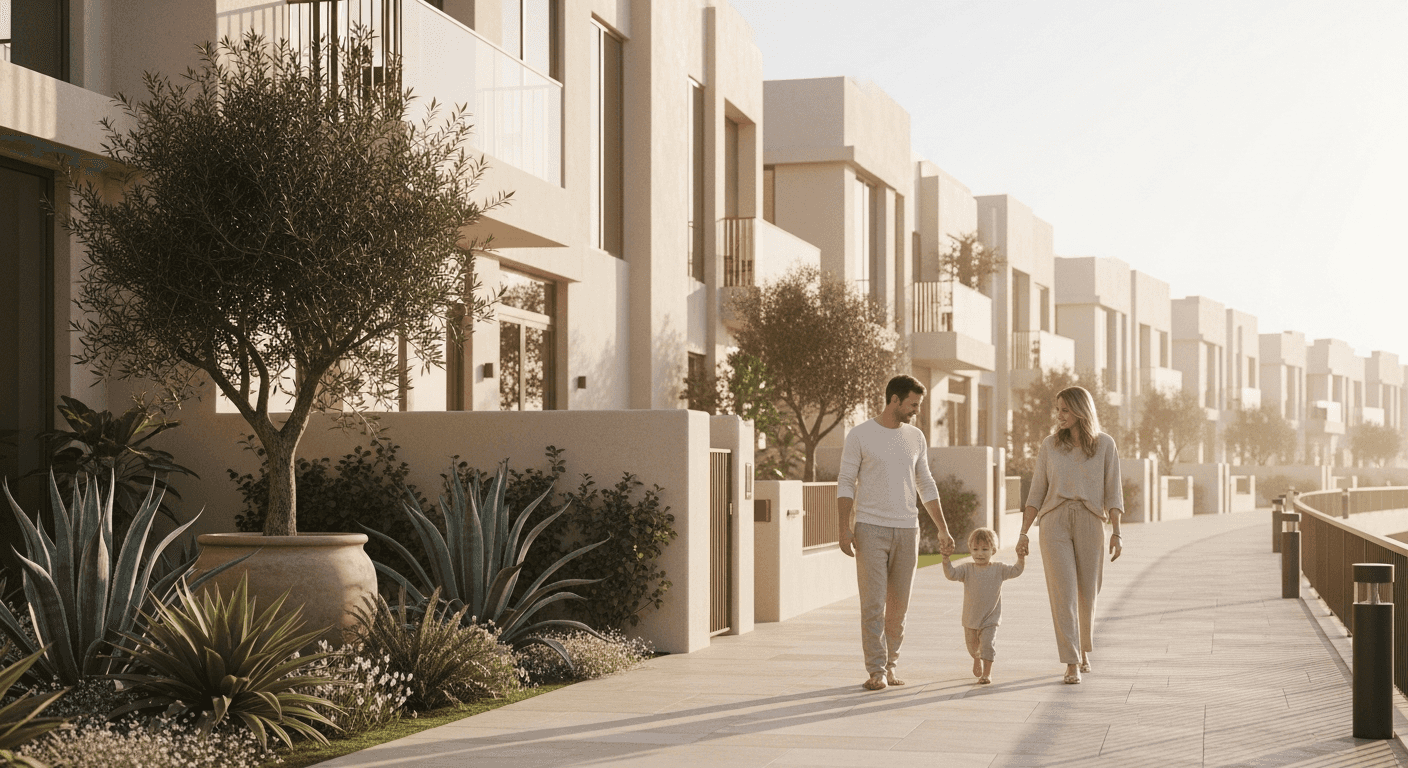
When clients tell me they miss the feeling of stumbling upon a hidden cafe or walking to the cinema on a Tuesday night, I often take them to City Walk. It, along with its waterfront cousin Bluewaters Island, represents one of the most successful architectural experiments in Dubai. The design philosophy here is a direct counter-argument to the car-centric, high-rise model. The architecture is defined by a human-scale, mid-rise urban grid. Buildings are typically G+6 or similar, maintaining a connection to the street. The façades are detailed and varied, borrowing from the language of established European city centres with brickwork, glass, and intricate metal detailing. The ground floor is almost entirely dedicated to active uses: boutiques, restaurants, cafes, and entertainment venues.
This design directly engineers a specific lifestyle. By prioritising the pedestrian with wide, often shaded walkways and placing amenities within a few minutes' walk, it encourages residents to leave the car behind. Your daily routine changes. A morning coffee isn't a drive-thru event; it’s a short stroll to a local barista. You meet neighbours on the street, not just in the elevator. The community feels alive and interactive because the architecture forces points of social connection. It's a lifestyle of convenience and spontaneity, appealing immensely to young professionals, couples, and those who crave the vibrant energy of a downtown core but in a more curated and pristine environment. This is a prime example of how architectural communities Dubai have become lifestyle destinations in their own right.
Of course, this lifestyle comes with trade-offs. The density is higher than in a suburban villa community. While apartments can be spacious, you are sacrificing the sprawling private garden for shared public realms and balconies. The price per square foot reflects this curated convenience; you are paying a premium for the walkability and the built-in amenity network. A two-bedroom apartment in City Walk can command a rental income and sale price significantly higher than a comparable unit in a more traditional, car-dependent tower community. The service charges also reflect the high level of maintenance required for the pristine streets, landscaping, and public art. For residents, it's a calculated decision: they are buying into a smooth, hassle-free urban experience, and the architecture is the primary enabler of that promise.
Case Study 2: Biophilic Sanctuaries — Where Nature Designs the Home
At the complete opposite end of the spectrum lies another powerful architectural narrative: biophilic design. If City Walk is about embracing the urban fabric, communities like Al Barari are about escaping into a man-made Eden. Here, the central design principle is the integration of humanity and nature. The developer, who also happens to be a passionate landscape architect, dedicated a huge proportion of the master plan not to built-up area, but to themed gardens, lush forests, and winding waterways. The result is a microclimate that feels several degrees cooler than the surrounding desert and a soundscape dominated by birdsong and flowing water rather than traffic.
This philosophy permeates the architecture of the homes themselves. Villas in Al Barari, and in similar high-end projects by boutique developers like Zaya, are designed to erase the boundary between inside and out. You'll find floor-to-ceiling glass walls that disappear, terraces that flow into private pools, and courtyards that bring gardens into the very heart of the home. Natural materials like wood and stone are used extensively, creating a tactile and serene environment. These are some of the most sought-after Dubai designer homes because they offer a lifestyle centred on wellness, privacy, and tranquility. It's for the family who wants their children to grow up surrounded by nature, or the executive who needs a genuine sanctuary to decompress from the pressures of city life.
This immersive, nature-led lifestyle comes at a significant cost. Al Barari is one of Dubai's most exclusive and expensive communities, with villas commanding prices in the tens of millions of dirhams. The service charges are also among the highest in the city, a necessity to fund the army of gardeners and technicians required to maintain this botanical masterpiece in the middle of the desert. Life here is also inherently car-dependent; the very seclusion and space that make it desirable mean that schools, malls, and offices are a drive away. Yet for its residents, this is a price worth paying. They aren't just buying a large villa; they are investing in a rarefied atmosphere, clean air, and a sense of peace that is almost impossible to find elsewhere in a major global metropolis.
Case Study 3: The New Classicism — Tradition Reimagined for Modern Luxury
While modernism and biophilia represent two dominant trends, there remains a powerful and enduring appetite for classicism in Dubai's high-end property market. This isn't about recreating historical pastiche; it's about reinterpreting traditional architectural forms — be they Mediterranean, Arabic, or grand European, for a contemporary audience. The flag-bearer for this approach is, of course, Emirates Hills, Dubai's original bastion of the ultra-wealthy. Here, the architectural narrative is one of grandeur, permanence, and bespoke luxury. The community is organized around vast plots of land, giving owners the freedom to commission architects to build their own palatial homes.
The resulting streetscape is an eclectic showcase of unique house styles Dubai, from Tuscan-inspired villas with terracotta roofs and stone cladding to stately mansions that evoke French chateaus or grand Arabian palaces. While the exteriors speak of tradition and legacy, the interiors are invariably state-of-the-art, with smart home technology, private cinemas, and underground parking for a collection of supercars. A similar, though more master-planned, approach can be seen in certain enclaves within Jumeirah Golf Estates, where communities of villas adhere to a specific classical theme, such as the 'Fire' course's desert-toned Tuscan style.
The lifestyle facilitated by this architectural choice is one of formality, privacy, and large-scale entertaining. These homes are designed not just for a family to live in, but for them to host, to build a legacy, and to project a certain status. The generous plot sizes ensure absolute privacy from neighbours. The internal layouts often feature formal reception rooms (majlis), grand dining halls, and extensive staff quarters, all designed to support a very particular, high-net-worth way of life. This architectural style appeals to a specific buyer, often established families or UHNWIs from cultures where the family home is the central pillar of social life. It stands in stark contrast to the minimalist, open-plan trends seen elsewhere, offering instead a sense of solidity, history, and unabashed opulence.
Starchitects and Super-Brands: The Rise of Trophy Residences
In the upper echelons of Dubai's property market, a new architectural narrative has become increasingly prominent: the 'trophy' residence. This phenomenon takes two primary forms: buildings designed by world-renowned 'starchitects' and residences branded by luxury fashion, jewellery, or automotive giants. A prime example of the former is The Opus by Zaha Hadid in Business Bay, a building so sculpturally unique it's as much a work of art as a place to live. The value proposition here is simple: you are buying a piece of architectural history, a home designed by a Pritzker Prize-winning visionary. The building's iconic status confers an immediate and lasting prestige upon its residents.
The second, and currently more explosive, trend is that of branded residences. Developers like Damac have pioneered this model, partnering with brands like de GRISOGONO, Cavalli, and Fendi, while others have followed suit. We now have Baccarat residences, Bugatti residences from developers like [Binghatti](/developers/binghatti], and Armani residences within the Burj Khalifa itself. This is about more than just slapping a logo on a tower. These partnerships often involve the brand's creative directors in the design of the interiors, lobby spaces, and amenities. The result is a completely immersive brand experience. Living in a Cavalli-branded tower means being surrounded by bold animal prints and opulent materials, while a de GRISOGONO residence might feature design motifs inspired by the jeweller's famous black diamonds.
“For the buyer of a branded residence, the architecture and interior design are signals of belonging to an exclusive club. It’s less about a specific lifestyle function and more about acquiring a collectible asset.”
The lifestyle promised by these properties is one of ultimate turnkey luxury and brand alignment. You're not just buying an apartment; you're buying into the aspirational world of that brand. This often comes with five-star hotel-style services, exclusive access to brand events, and the assurance of exceptionally high-quality finishes. From an investment perspective, the brand acts as a powerful marketing tool and a perceived guarantee of quality, which can justify a significant price premium over a non-branded building in the same area. The architectural narrative here is one of status, exclusivity, and living within a meticulously curated aesthetic. It's the ultimate expression of aesthetic living Dubai as a purchasable commodity.
The AED Question: Quantifying the Value of Great Design
As much as I appreciate the poetics of architecture, my clients rightfully expect a pragmatic financial analysis. Does good design actually pay? The answer, unequivocally, is yes. A property within a well-conceived, architecturally significant community consistently commands a higher price, achieves better rental yields, and demonstrates superior value retention compared to its generic counterparts. The premium isn't for the aesthetics alone; it's for the tangible quality of life and the robust demand that a strong architectural narrative creates. A two-bedroom apartment in a design-led project by Meraas or Emaar Properties will be valued not just on its size, but on its proximity to the community's curated park, its walking distance to a desirable restaurant, and the overall quality of the master plan.
However, buying into these communities means understanding the full cost structure. The sticker price is only the beginning. Let's walk through a realistic, line-by-line breakdown for purchasing a hypothetical AED 3 million apartment in a prime, design-led community. This is a crucial exercise we undertake with every client at Gaia Living to ensure complete transparency.
Sample Upfront Cost Breakdown for an AED 3,000,000 Property: - Purchase Price: AED 3,000,000 - Dubai Land Department (DLD) Transfer Fee: 4% of the purchase price, which is AED 120,000. This is typically split 50/50 between buyer and seller but is often paid fully by the buyer in the secondary market. - Property Registration Fee: AED 4,000 + 5% VAT (AED 200), totaling AED 4,200. - Real Estate Agency Fee: 2% of the purchase price + 5% VAT. That's AED 60,000 + AED 3,000, for a total of AED 63,000. - Developer's No Objection Certificate (NOC) Fee: This varies, but a typical range is AED 500 to AED 5,000. Let's budget AED 1,500. - Mortgage Fees (if applicable): If you're financing 80% (AED 2.4M), you'll pay a mortgage registration fee to the DLD of 0.25% of the loan amount, which is AED 6,000. Banks also charge arrangement fees, typically 0.5% to 1% of the loan value. - Total Estimated Upfront Cost (excluding bank fees): Approximately AED 3,188,700.
Beyond the upfront costs are the recurring service charges. These are the lifeblood of architecturally ambitious communities, funding the maintenance of the lush landscapes, pristine pools, 24/7 security, and unique amenities. In a standard tower, you might pay AED 15-22 per square foot per year. In a community like Dubai Hills, it could be similar. But in a high-service, design-intensive community like City Walk or Downtown Dubai, expect AED 25-35 per sqft. In an ultra-luxury, biophilic paradise like Al Barari, charges can exceed AED 40-50 per sqft. For a 2,000 sqft apartment, a charge of AED 30/sqft means an annual bill of AED 60,000. This is a significant factor in your total cost of ownership, and it’s essential to weigh it against the lifestyle benefits you receive.
How to Read the Blueprint: A Buyer's Guide to Architectural DNA
When you're looking at modern design properties, it’s easy to be seduced by a stunning lobby or a slick rendering. But to make a truly wise investment, you need to learn how to 'read' the architecture for clues about its long-term quality and the lifestyle it will actually deliver. At Gaia Living, we guide our clients to look beyond the surface and analyze the architectural DNA of a property. It’s a skill that can save you from costly mistakes and lead you to a home you'll love for years.
Here is a practical checklist I use when evaluating a property or community. I encourage you to adopt the same critical eye:
- Evaluate the Master Plan: Before looking at the individual unit, zoom out. Is this a coherent master plan or a chaotic jumble of plots? Look for thoughtful integration of green spaces, retail, schools, and transportation links. A great master plan, like that of Emaar Properties in Dubai Hills, creates value for every single property within it.
- Examine the Façade and Materials: The building's exterior is its business card. What is it saying? Does it use high-quality, durable materials like natural stone, well-finished metal, or high-performance glass? Or does it rely heavily on painted stucco, which can stain and degrade under the Dubai sun? The choice of materials is a direct indicator of the developer's commitment to quality versus cost-cutting.
- Interrogate the Lobby and Amenities: The lobby is the developer's mission statement. Is it designed to impress, or is it designed to be used? Look for comfortable seating areas, functional concierge desks, and a welcoming atmosphere. The same applies to amenities. A rooftop pool with a stunning view is great, but is there adequate shade? Is the gym equipped with high-quality machines or cheap alternatives? The details here reveal the developer's true priorities.
- Deconstruct the Floor Plan: This is arguably the most critical element for your day-to-day life. Ignore the fancy furniture in the show home and focus on the flow. Is there a lot of wasted space in long, awkward corridors? Where does the morning light come from? Is there a proper service entrance and sufficient storage? Does the layout support how you and your family *actually* live? A beautiful building with a dysfunctional floor plan is a design failure.
- Review the Developer's Back Catalogue: The best predictor of future performance is past behaviour. Visit older projects by the same developer. How have they aged? Are the communities still well-maintained? Talk to residents about their experience with the management and the service charges. A developer like Nakheel, with a vast portfolio including Palm Jumeirah, has a long and visible track record you can assess.
By systematically working through these points, you move from being a passive consumer of design to an active, informed critic. This allows you to identify genuine quality and find a home whose architectural narrative is truly aligned with your own.
My Verdict: Finding Your Architectural Match in Dubai
After years of walking clients through countless properties across this city, from gleaming penthouses on Palm Jumeirah to serene villas in Arabian Ranches, my core conviction has only deepened: the best architecture is a form of empathy. It’s a deep understanding of the end-user’s needs, desires, and daily rhythms, translated into physical form. The most successful architectural narratives in Dubai are not the ones that shout the loudest, but the ones that listen the most intently to the residents they serve.
There is no single 'best' architectural style. The stark modernism that inspires a young fintech entrepreneur in DIFC would feel cold and uninviting to a family seeking the warm, communal spirit of a suburban neighbourhood. The opulent classicism of an Emirates Hills mansion is a dream for one buyer and a gilded cage for another. The goal, therefore, is not to find the most critically acclaimed or fashionable design, but to find the most authentic alignment between a property's built-in lifestyle script and your own personal story.
In my view, the developers who are truly excelling are those who commit to a singular vision and execute it with integrity. Meraas continues to be a standard-bearer for creating vibrant, human-centric urban spaces. The sustained commitment of Al Barari to its biophilic vision is remarkable. Emaar's ability to create balanced, comprehensive communities like Dubai Hills Estate, which cater to a wide range of lifestyles within a single, cohesive master plan, is a masterclass in placemaking. The new wave of design-forward, boutique developers is also bringing fresh energy and unique perspectives to the market, which is incredibly exciting to watch.
When you begin your property search, I urge you to think like a lifestyle critic. Ask yourself: What story does this building tell? What daily routines does this layout encourage? What kind of community does this master plan foster? By focusing on the narrative embedded in the architecture, you move beyond simply buying square footage and begin the more meaningful process of investing in your own well-being and happiness. The perfect home isn't just a place to live; it's the stage on which your best life can unfold. And our job, at Gaia Living, is to help you find it.
## Sources - Dubai Land Department (DLD): dubailand.gov.ae - Real Estate Regulatory Agency (RERA): rera.gov.ae - UAE Government Portal: u.ae
Questions, answered
- What are typical service charges in a designer building in Dubai?
- Service charges vary greatly. Expect AED 15-25 per square foot in standard buildings, but in design-led communities with extensive amenities like City Walk or Al Barari, charges can easily be AED 30-50 per square foot or higher to maintain the superior environment.
- Is it more expensive to buy in an architecturally significant community?
- Yes, there is a definite premium. Well-designed communities by reputable developers command higher prices due to superior build quality, unique amenities, and the desirable lifestyle they offer. This premium often translates into better value retention over time.
- Which developers are known for good design in Dubai?
- Developers like Meraas, Emaar, and Zaya are renowned for their focus on creating architecturally distinct communities. Meraas excels at urban, walkable spaces, Emaar Properties creates balanced master communities, and Zaya specialises in ultra-luxury, nature-integrated homes.
- Does a famous architect's name add real value to a Dubai property?
- A 'starchitect' or luxury brand collaboration definitely adds a price premium and significant brand cachet. While it can be a strong marker of quality and exclusivity, discerning buyers should still evaluate if the underlying design and floor plan truly suit their lifestyle, beyond just the name.
- What is 'biophilic design' in Dubai real estate?
- Biophilic design is an architectural approach that seeks to connect building occupants more closely with nature. In Dubai, this is seen in communities like Al Barari, which feature extensive green landscapes, natural water features, and homes with smooth indoor-outdoor living spaces.
- How does architecture affect walkability in Dubai?
- Architecture is fundamental to walkability. Communities like City Walk use human-scale, low-rise buildings, active ground floors with retail, and shaded walkways to create a pleasant pedestrian environment, encouraging a less car-dependent lifestyle.

Yusuf writes about how Dubai actually lives — waterfront mornings, community dining, walkability, and the lifestyle premium built into an address.
Related stories
Off-Plan vs Ready: The Dubai Investor's Guide
A detailed comparison for apartment investors in Dubai, weighing the capital appreciation potential of off-plan against the immediate returns of ready properties.

Clearing Disputes for a Smooth Dubai Sale
Unseen property disputes or financial encumbrances can derail your Dubai property sale. I'll share my strategic playbook for identifying and resolving these issues before they cost you time and money.
Selling Inherited Property in Dubai: The Complete Guide
Navigating the sale of an inherited property in Dubai requires a clear understanding of the specific legal and financial steps. This guide covers the entire process, from obtaining a succession certificate to the final transfer.
Echoes, in your inbox
One thoughtful email a month. Market insight, new launches, no spam.