

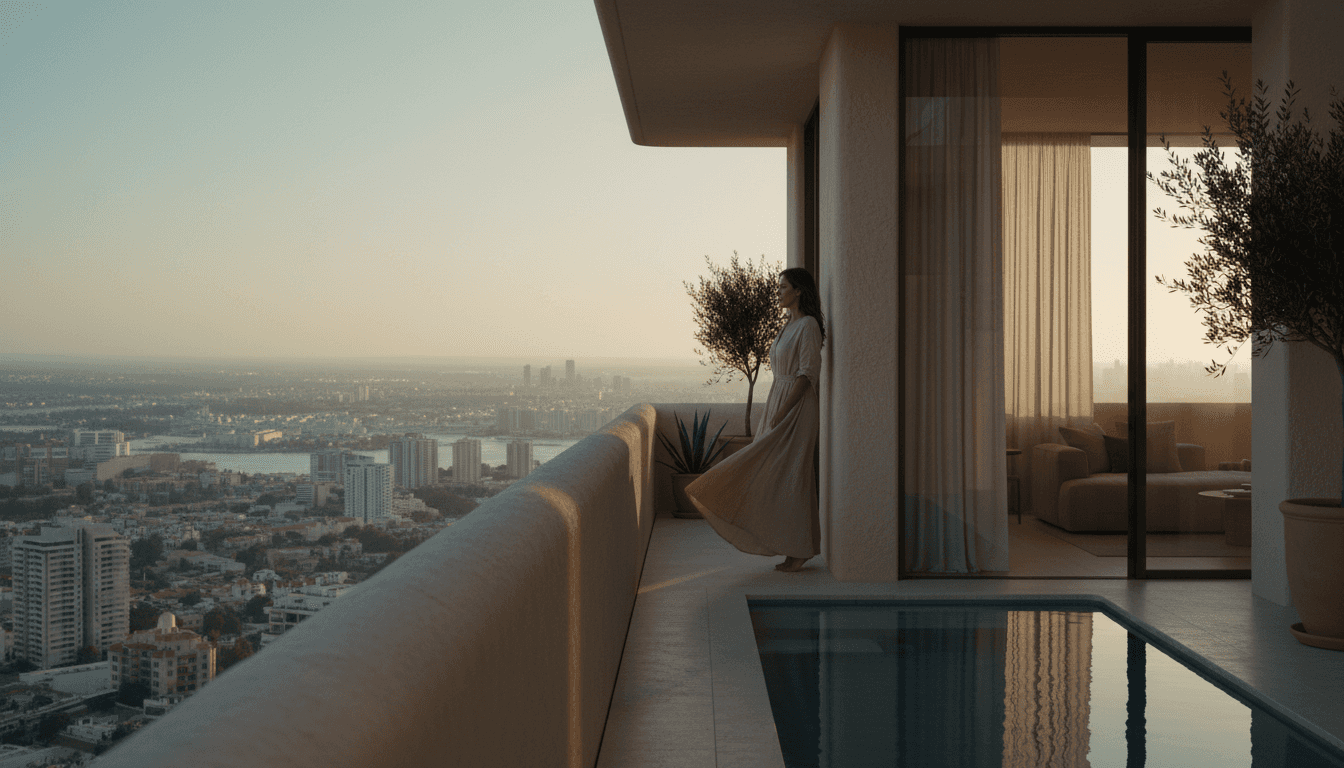
A Guide to Apartment Orientation in Dubai
Your apartment's direction matters more than you think. I'll break down how sun, views, and privacy are shaped by orientation, and how this impacts your quality of life and the property's real estate value in Dubai.

As an apartment specialist, I've seen buyers fall in love with a view, only to find the reality of living there is a daily battle with the sun. An apartment’s orientation — the direction its main windows and balconies face, is one of the most overlooked yet critical factors for your happiness and the property’s long-term value.
Here's what we'll explore in this detailed guide:
- The Four Cardinal Directions: What each means for light and heat in Dubai.
- The Financial Impact: How orientation affects your DEWA bill and service charges.
- View Lines vs. Views: The crucial difference and its impact on value.
- Privacy & Proximity: Assessing how orientation affects being overlooked.
- Masterplan & Future-Proofing: Looking beyond your building to what's next door.
- The Role of Architecture: How good design can mitigate a bad orientation.
- A Practical Checklist: Your step-by-step guide for viewings.
The Four Cardinal Directions: Sun Exposure in Dubai
When you're standing on a balcony in Dubai, the direction you're facing dictates the light, heat, and overall ambience of your home for years to come. The intense local climate means that `apartment sun exposure Dubai` is not a trivial matter; it's a core component of your living experience. Forgetting this can lead to uncomfortably hot rooms, faded furniture, and unexpectedly high utility bills. Let's break down each direction from a Dubai perspective.
A north-facing apartment is often considered the most desirable for practical, day-to-day living. It receives indirect, consistent sunlight throughout the day without the harsh glare or intense heat of a direct beam. This creates a soft, ambient light that's ideal for living spaces and home offices. The key advantage is thermal comfort. These apartments stay significantly cooler, especially during the peak summer months from May to September. This translates directly into lower energy consumption for air conditioning, a major household expense. For art collectors or those with delicate wooden furniture, the lack of direct UV exposure is a significant bonus, preventing fading and damage over time. The primary downside? You won't get those dramatic sunrises or sunsets directly into your living room.
Conversely, a `south-facing apartment Dubai` is a sun trap. It receives the full force of the sun for most of the day, particularly in the winter when the sun is lower in the sky. While this might be a plus in colder climates, in Dubai it means a constant battle against heat gain. The internal temperature of a south-facing unit can be several degrees higher than a north-facing one in the same building. This makes high-performance, double-glazed or coated windows an absolute non-negotiable. Without them, your AC will be working overtime, and you'll feel it on your DEWA bill. Some people enjoy the bright, direct light, but it can be overpowering, creating glare on screens and making certain rooms unusable at peak times without heavy blackout curtains.
East-facing apartments capture the morning sun. This is perfect for early risers who enjoy waking up to bright, cheerful light. The apartment gets its direct sun exposure out of the way early, and for the rest of the day, it enjoys more moderate, indirect light while staying cooler in the hot afternoons. This can be a great balance. West-facing apartments are the opposite, getting the full force of the afternoon and evening sun. This is where you'll get spectacular sunset views, but it comes at a cost. The apartment heats up throughout the afternoon, retaining that heat into the evening. This is often the hottest orientation, as the sun is intense right up until it sets, meaning your AC will be running at full blast just as you're settling in for the evening. Balconies can become almost unusable in the late summer afternoons due to the intense, direct heat.
The Financial Impact: DEWA Bills and Hidden Costs
 Featured project
Many buyers focus on the headline purchase price, but the `building orientation real estate value` extends deep into the running costs of the property. The most direct financial impact of your apartment’s orientation is on your monthly DEWA (Dubai Electricity and Water Authority) bill. Air conditioning is the single largest contributor to electricity consumption in any Dubai home, and an apartment's heat gain is the primary driver of AC usage. The difference between a well-oriented and a poorly oriented apartment is not trivial; it can amount to thousands of dirhams per year.
Consider two identical 1,000 sq. Ft. one-bedroom apartments in the same tower in Business Bay. The north-facing unit, with its indirect light, might maintain a comfortable indoor temperature with the AC set to 23°C and running moderately. The south-facing unit, absorbing direct solar radiation all day, may require the AC to be set to 21°C and running constantly just to achieve the same level of comfort. This difference in workload could easily translate to a 15-25% higher electricity bill for the southern unit. Over a year, this could be an extra AED 1,500 - AED 3,000. Over a five-year ownership period, that’s a significant sum that could have gone towards service charges or other investments.
Beyond the DEWA bill, there are other, less obvious costs. Service charges themselves can be indirectly affected. While calculated on a per-square-foot basis for the whole building, developers factor in the expected operational costs of the entire building's common areas when setting these fees. Buildings with a large proportion of south or west-facing glass facades will have higher collective cooling costs for lobbies, gyms, and hallways, which is ultimately passed on to all owners. Beyond that, think about the capital cost of window treatments. A south-facing apartment with floor-to-ceiling glass might require an investment of AED 15,000 - AED 25,000 in high-quality, motorised blackout blinds and thermal curtains just to be comfortable. In a north-facing unit, simpler, more decorative curtains might suffice for a fraction of the cost.
Here’s a simplified breakdown of how orientation can influence your annual running costs for a hypothetical 2-bedroom apartment:
- North-Facing Unit (Cooler):
- Average Monthly DEWA (AC focused): AED 700
- Annual DEWA Cost: AED 8,400
- Required Window Treatments: Standard curtains/blinds - AED 5,000 (one-off)
- First Year Cost Focus: AED 13,400
- South-Facing Unit (Hotter):
- Average Monthly DEWA (AC focused): AED 900 (28% higher)
- Annual DEWA Cost: AED 10,800
- Required Window Treatments: Thermal blackout blinds - AED 15,000 (one-off)
- First Year Cost Focus: AED 25,800
This is a simplified illustration, but it shows how the initial appeal of a bright, sunny apartment can come with a steep and recurring price tag. When we at Gaia Living advise clients, we always encourage them to think about the total cost of ownership, not just the purchase price. The orientation is a fundamental part of that calculation.
View Lines vs. Views: A Crucial Distinction
This is a concept I spend a lot of time explaining to clients, because it’s where a lot of value is either created or destroyed. A 'view' is what you can see today. A 'view line' is the protected, permanent corridor of sight you have from your property. The difference is everything. A stunning view of an empty plot of land is temporary. A view line that looks over the sea, a protected park, or a low-rise heritage area is permanent. The market prices this difference accordingly.
`View lines apartment impact` is most pronounced in hyper-dense, vertical communities like Dubai Marina or Downtown Dubai. Here, a new tower can completely erase the prized sea view of a neighbouring building, impacting its desirability and value overnight. When assessing a property, you must think like a city planner. Look at the masterplan for the area. Are the plots around your potential building designated for high-rise, mid-rise, or villas? Is there a major road, a canal, or a park that acts as a natural buffer, protecting your view line in perpetuity? A classic example is the difference between apartments in JBR and Emaar Beachfront. Many apartments in Jumeirah Beach Residence have beautiful sea views, but they are often partially filtered through other towers. At Emaar Beachfront, the masterplan by Emaar Properties orients towers to maximise protected sea and marina views. An apartment there with a direct, unblockable view towards the Palm or the Marina skyline commands a significant, durable premium.
This is why orientation and elevation are so intertwined. A low-floor apartment, even with a great orientation, is more vulnerable to having its view blocked by future construction. A high-floor apartment (say, above the 40th floor) is far more likely to retain its view line over surrounding developments. When considering an off-plan property from a developer like Nakheel on Palm Jebel Ali, it's critical to study the full masterplan they provide. Where will the other towers be? How tall will they be? Your sales advisor should be able to provide a detailed plot-by-plot plan. Don't just look at the pretty render of your own building; look at the schematic of the entire district.
“The view you pay for today is not guaranteed tomorrow unless it's a protected view line. Always investigate the future of the plots adjacent to your building.”
The most valuable view lines in Dubai are typically those that cannot be built out. These include direct, front-row sea views (like on Palm Jumeirah or Jumeirah Bay), views over the golf courses in communities like Emirates Hills or Arabian Ranches, or direct, head-on views of iconic landmarks like the Burj Khalifa or the Ain Dubai on Bluewaters Island. An east-facing apartment in Downtown overlooking the Burj Khalifa and the fountains has a more durable premium than a west-facing one with a sea view that could one day be obstructed by development along Sheikh Zayed Road. Understanding this distinction is key to making a sound investment.
Privacy & Proximity in Vertical Living
Beyond sun and views, orientation dictates your level of privacy. In a city of towers, this is a paramount concern. `Privacy apartment living Dubai` is a luxury that is increasingly sought after, and it's directly tied to how your apartment is angled relative to its neighbours. A beautiful wall of glass is a liability if it gives you a direct view into your neighbour's living room, and them into yours. This is where the specific layout of the tower and the micro-positioning of your unit on the floor plate become critical.
When you're on a viewing, don't just look out; look across. How close is the next building? Can you see directly into their windows? More importantly, can they see into yours? I've seen apartments in DIFC where two towers are so close that residents can practically wave to each other from their sofas. While this offers a vibrant, urban feel, it compromises privacy. In contrast, consider a corner unit. These often have a dual aspect (e.g., north and east), providing varied light and, crucially, views in two different directions. This often means at least one of your windowed walls isn't facing another building directly, creating a natural pocket of privacy. This is why corner units often sell for a premium and are the first to be reserved in new launches.
Developers are becoming more conscious of this. In well-designed modern towers, you'll see architects use fins, angled balconies, and strategically placed solid walls to break up sight lines between adjacent apartments and neighbouring buildings. In projects like those by Omniyat, known for their architectural focus, you can see how the very form of the building is sculpted to enhance privacy for each residence. They might stagger balconies or angle the entire facade to direct the gaze outwards, towards the primary view, rather than sideways towards a neighbour. This is a hallmark of premium design that you don't always find in more mass-market developments.
Your choice of community also plays a huge role. In sprawling, mid-rise communities like those in Arjan or Al Furjan, the distance between buildings is generally greater than in the high-density core. This automatically affords more privacy. However, even here, orientation matters. An apartment overlooking a central community pool will be less private than one overlooking a quiet side street or landscaped garden. When assessing privacy, consider all times of day. A quiet-seeming balcony might be directly overlooked by a busy pool deck in the afternoon or a brightly lit commercial space at night. True privacy is a 24/7 attribute and a key driver of residential comfort.
Analysing the Masterplan for Future-Proofing
Buying an apartment, especially off-plan, is an act of faith in the developer's vision for the entire community. The orientation and value of your unit are not just determined by your building, but by the entire masterplan surrounding it. A savvy buyer looks beyond their own plot and scrutinises the plan for the whole district to future-proof their investment. This is where developers like Emaar, Nakheel, and newer players like Sobha Realty with their large-scale community plans offer a degree of certainty.
When we review a new launch, for example at Dubai Creek Harbour, the first thing we do is pull up the complete masterplan from the Dubai Land Department or the developer. We are looking for answers to several key questions:
- Future Construction: What are the designated heights of the plots in front of my view line? Is that empty sandlot destined to be a park or another 60-storey tower? The zoning regulations and registered masterplan are your best guide here.
- Infrastructure: Where are the main access roads, metro stations, and public facilities going to be? An apartment facing a future six-lane highway will have noise and pollution issues, while one facing a future park or promenade will see its value appreciate.
- Commercial vs. Residential: Is your residential tower located next to a future bustling commercial square or a quiet residential block? This will impact noise, traffic, and the overall character of your immediate vicinity.
- Phasing: In large, multi-year projects, which phase is being built first? Being in an early phase can mean years of living next to a construction site. This might be acceptable if you've secured a very good price, but it's a lifestyle compromise. A unit in a later phase, or one oriented away from the future construction, will offer more peace.
Take a community like Jumeirah Village Circle (JVC). It's a patchwork of plots developed by many different builders. The original masterplan by Nakheel provided a framework, but the execution by dozens of private developers has been inconsistent. This makes due diligence on neighbouring plots absolutely essential. An apartment there might have a lovely park view today, but the plot next door could be designated for a tower that will entirely block it. In contrast, in a single-developer master-planned community like Nshama's Town Square, the entire layout, from parks to building placements, is designed cohesively from the start. This provides a much higher degree of confidence in the long-term integrity of your view and privacy.
Never take a sales agent's verbal promise about a 'future park' or 'unobstructed view' at face value. Ask to see the official, registered affection plan (the plot plan) for your plot and the surrounding ones. This document, available through the DLD's systems, is the legal blueprint. Analysing it is a core part of the due diligence we perform for our clients. It’s the only way to be reasonably sure that the view and orientation you’re buying today will still exist in five or ten years.
The Role of Architectural Design
While orientation is a fixed geographical reality, clever architecture and thoughtful design can work with it to enhance its strengths and mitigate its weaknesses. The quality of the building's design can be the difference between a south-facing apartment that's an unbearable greenhouse and one that's a bright, pleasant home. As a buyer, you need to learn to spot the signs of superior architectural thinking.
The most critical element is the glazing. In Dubai's climate, the type of glass used in the windows is not a minor detail. Look for 'low-E' (low-emissivity), double-glazed windows with a high-performance thermal coating. This technology allows visible light to pass through but reflects a significant portion of the infrared radiation (heat). A top-tier developer like Muraba on the Palm Jumeirah, for instance, made a point of using minimalist German glazing systems designed to maximize views while minimizing heat gain. This is a costly feature, and its presence is a strong indicator of a quality build. In a south or west-facing unit, it's an absolute necessity.
Beyond the glass, look at the building's structure. Are there architectural elements that provide passive shading? Deeply recessed balconies, for example, self-shade the windows behind them for part of the day. Overhangs (brise-soleil) above windows can block the high summer sun while allowing the lower winter sun to enter. Even the colour of the facade matters; lighter-coloured buildings reflect more heat than dark-coloured ones. These are not just aesthetic choices; they are functional design decisions that impact the building’s thermal performance and your comfort.
Even the floor plan itself is a tool. A well-designed layout might place less-used rooms (like utility rooms or guest bathrooms) along the hottest-facing wall, using them as a thermal buffer for the main living areas and bedrooms. It might position the living room to capture the premium view, while the bedrooms face a quieter, cooler direction for better sleep. At Gaia Living, we always scrutinise floor plans. We look for efficiency, flow, and how the layout interacts with the unit's orientation. A long, narrow floor plan with windows only at one end (a 'bowling alley' layout) will have very different light and ventilation characteristics from a square, dual-aspect corner unit. Good design makes the most of any orientation.
A Practical Checklist for Viewings
When you are finally on-site to view a property, it's easy to be captivated by the staging and the headline view. To make a truly informed decision, you need a systematic approach. I advise my clients to use a mental checklist to evaluate the orientation and its implications practically. Go prepared, and don't be afraid to take your time.
Here’s a step-by-step guide to use during your next apartment viewing:
1. Use Your Compass: Before you even step inside, pull out your phone's compass app. Note the exact direction the main windows and balcony face. Don't guess. Is it true north, or north-east? That small difference matters for morning vs. Midday sun.
2. Visit at Different Times: This is the single most important piece of advice I can give. A property can feel completely different at 9 am versus 4 pm. If you can, visit a shortlisted property at least twice, once in the morning and once in the late afternoon. See where the sun falls. Is the glare on the TV? Is the balcony too hot to use?
3. Look Down, Not Just Out: From the balcony, look directly down. What's below you? A noisy restaurant terrace? The building's garbage collection area? The pool? This ground-level activity will be part of your soundscape.
4. Assess the Neighbours (Horizontally and Vertically): Look directly across to the next building. Can you see into their units clearly? Then, look at the balconies above and below you. Are they directly stacked, or are they staggered for privacy? Can someone on a higher floor look directly down onto your entire balcony?
5. Check the Windows and AC: Physically inspect the windows. Are they double-glazed? Ask the agent for the building's technical specifications if possible. Turn on the AC. Is it noisy? How quickly does it cool the space? In a south or west-facing unit, a weak or old AC system is a major red flag.
6. Simulate the Future: Stand in the main room and look towards the best view. Now, use your hand or a piece of paper to block out any adjacent empty plots. What's left of your view? This simple exercise helps you visualize the impact of future construction.
7. Ask the Hard Questions: Don't be shy. Ask the agent or current owner directly: "What are the average DEWA bills in summer?", "What is the designated use for that empty plot next door?", "Have there been any issues with noise from the street/pool/neighbours?" Their answers (or lack thereof) are telling.
Taking this methodical approach moves you from being a passive viewer to an active inspector. It grounds your decision in practical reality, not just emotional appeal. This diligence is what separates a satisfactory purchase from a truly great one.
The direction your apartment faces is as fundamental to its value and your enjoyment as its square footage or location. By understanding the interplay of sun, views, and privacy, and by conducting thorough due-diligence on both the building and its masterplan, you can make a choice that brings comfort and financial sense for years to come. Never underestimate the power of a compass.
Sources
- Dubai Land Department (DLD): dubailand.gov.ae
- Central Bank of the UAE: centralbank.ae
- UAE Government Portal: u.ae
Questions, answered
- Which facing apartment is best in Dubai?
- North-facing apartments are often preferred in Dubai for their indirect, consistent light and lower heat gain, which can reduce cooling costs. However, the 'best' direction depends on personal preference for morning or evening sun, and the specific view the apartment offers.
- Is a south-facing apartment bad in Dubai?
- Not necessarily, but a south-facing apartment in Dubai will receive the most intense, direct sunlight, especially in summer. This leads to higher heat gain and potentially higher DEWA bills for air conditioning. Buyers should ensure the building has high-quality, heat-reflective glazing to mitigate this.
- How does building orientation affect real estate value in Dubai?
- Building orientation real estate value is significant. Apartments with premium, protected views (e.g., full sea view, Burj Khalifa view) and those with optimal sun exposure (often north or east-facing) can command higher prices and retain their value better than units with obstructed views or harsh southern exposure.
- What is the benefit of a north-facing apartment in Dubai?
- The main north-facing apartment benefits in Dubai are cooler internal temperatures and soft, indirect natural light throughout the day. This creates a comfortable living environment without the harsh glare and heat of direct sun, helping to lower air conditioning expenses.
- How important is privacy in a Dubai apartment?
- Privacy in apartment living in Dubai is a major factor for many residents. An apartment's orientation and its relationship to nearby buildings directly impact privacy. Units that are not overlooked by neighbours command a premium and offer a greater sense of sanctuary, especially in dense areas like Dubai Marina or Business Bay.

Ravi lives and breathes apartment living — from studio yields in JVC to branded residences on the Palm. Floor plans, service charges, and view lines are his love language.
Related stories
Firing Your Dubai Agent: A Seller's Strategic Guide
Feeling stuck with an underperforming agent in Dubai? This guide outlines the clear signs it's time for a change and the precise steps to terminate your listing contract professionally and effectively.
The Ultimate Off-Plan Due Diligence Guide for Dubai
My definitive guide to navigating the complexities of buying off-plan property in Dubai. Learn the essential checks that protect your capital and ensure you're investing in a project with real potential.
The Engine Room: Dubai's Industrial Surge & Its Housing Echo
I explore how the boom in Dubai's logistics and industrial real estate is creating powerful, often overlooked, ripple effects in the residential property market.
Echoes, in your inbox
One thoughtful email a month. Market insight, new launches, no spam.